Modern researchers have access to more information than any generation before them. Academic databases, preprint servers, patents, technical documentation, industry reports, internal experiments, conference papers, and specialist communities make it possible to discover relevant material in minutes.
The problem is that finding information is only the beginning.
A researcher may read twenty papers on a topic, save another thirty for later, highlight important findings, write notes in different places, bookmark several technical articles, compare patents, review experiment results, and discuss conclusions with colleagues. For a while, everything feels manageable.
Then a few weeks pass.
A new question appears.
Which paper showed that result? Was that conclusion supported by two studies or five? Which experiment contradicted the original hypothesis? Was that finding based on a small sample? Did another team already test something similar? Which patent described the mechanism differently?
At that moment, the researcher is no longer searching for information.
They are reconstructing what they already learned.
That reconstruction is one of the most expensive and underestimated parts of research work.
Research Has an Information Problem, but Not the One Most People Think
The standard assumption is that researchers need better discovery tools.
Sometimes they do.
Finding the right paper, patent, dataset, or technical report can still be difficult. Search quality matters, access matters, and filtering irrelevant results matters.
But once a researcher has already found enough relevant material, a different problem begins.
The challenge shifts from discovery to synthesis.
At that point, the researcher is dealing with dozens or hundreds of fragments of knowledge. Some are highly relevant. Some are outdated. Some reinforce one another. Some contradict previous conclusions. Some are useful only when connected to another source.
The research task becomes less about finding one answer and more about building a reliable mental model from many imperfect pieces.
That is significantly harder.
Reading Is Not the Same as Remembering
Researchers often assume that once something has been read and understood, it will be easy to retrieve later.
That assumption fails quickly at scale.
A paper may be completely clear while you are reading it. You understand the methodology, remember the key result, and see exactly why it matters.
Two months later, much of that detail is gone.
You may remember the general conclusion but forget the conditions under which it was true. You may remember that a study supported your hypothesis but forget that the sample was limited. You may remember that two papers disagreed but forget what caused the difference.
This creates a dangerous gap between familiarity and usable knowledge.
A source can feel familiar without being accurately remembered.
That matters because research decisions often depend on nuance.
The difference between “this approach works” and “this approach worked under one specific condition” may completely change the next experiment, product decision, or technical direction.
Literature Reviews Become Harder Long Before They Become Large
A literature review with five papers is relatively easy to manage.
You can remember the main argument of each paper. You can compare methods manually. You can keep a rough map of the field in your head.
At twenty papers, the situation changes.
At fifty, it becomes much harder.
At one hundred, memory alone is no longer a reliable system.
The difficulty is not simply volume. The real problem is relationships.
Which findings repeat?
Which methodologies differ?
Which sources reference the same earlier work?
Which conclusions are strong?
Which ones depend on narrow assumptions?
Which paper challenged another paper’s result?
Which unanswered question appears repeatedly across the literature?
The value of the research often exists in those relationships, not in the individual documents.
That is why a folder full of PDFs is not a research system.
It is storage.
Researchers Constantly Rebuild Context
Imagine an R&D team investigating a new technical approach.
They begin with academic papers. Then they review patents. They compare competitor implementations. They run internal tests. Engineers leave notes. Product teams add market constraints. New research appears.
Three months later, someone asks a simple question:
“Why did we decide not to pursue Approach B?”
That question may require reconstructing several layers of evidence.
One paper suggested a technical limitation. An internal experiment confirmed part of it. A patent raised another concern. Engineering estimated high implementation complexity. A competitor later demonstrated a different solution.
The final decision may have been reasonable.
But if the context behind it is fragmented, the team has to rebuild the argument from scratch.
This is exactly the same problem individual researchers face, but at organizational scale.
Research memory becomes distributed across people, tools, documents, and time.
Notes Help, but Only Up to a Point
Most researchers already take notes.
The problem is not that note-taking does not work. The problem is that notes often become separated from the context that made them useful.
A researcher may write:
“Approach performs poorly under high load.”
That note may be meaningful today.
Six months later, it raises more questions.
Which approach?
Compared with what?
How high was the load?
Was this based on published research or an internal test?
Was the limitation later resolved?
Was the result replicated?
The note survived.
The context did not.
This is one reason research systems often become less useful over time. Information remains available, but the relationships around it decay.
Research Fragmentation Creates Duplicate Work
One of the most expensive consequences of weak research memory is duplication.
A researcher searches for information that someone else already found.
An engineer repeats an experiment because the previous result is difficult to locate.
A team reviews the same group of papers during a new project because nobody can quickly retrieve the conclusions from the earlier review.
A new employee reconstructs months of technical history because the people who originally worked on the problem have moved on.
This duplication is often invisible.
Nobody creates a report titled “Hours spent rediscovering things we already knew.”
But the cost is real.
In R&D environments, where research can be expensive and slow, repeating knowledge work unnecessarily is particularly damaging.
Contradictions Are Often More Valuable Than Summaries
Many research tools focus heavily on summarization.
Summaries are useful.
They save time and make long documents easier to review.
But a good research system needs to do more than produce shorter versions of individual papers.
The most valuable insight may exist between papers.
One study says a method improves performance. Another shows no improvement. A third finds benefits only under a specific condition.
A summary of each paper does not automatically reveal why they disagree.
The researcher needs to compare methodology, population, assumptions, datasets, environment, sample size, or measurement criteria.
This is where research becomes reasoning rather than reading.
The goal is not simply to know what each source says.
The goal is to understand how the sources relate.
Research Memory Should Preserve Evidence, Not Just Documents
A stronger research workflow should make it possible to move from documents toward evidence.
Instead of asking only:
“What did this paper say?”
Researchers should be able to ask:
“What evidence supports this hypothesis?”
“Which papers disagree with this conclusion?”
“What experiments tested this assumption?”
“What findings are repeated across multiple sources?”
“What evidence do we have against this approach?”
“Which source originally led us to this decision?”
This is a very different model.
The paper is still important.
But it becomes one component inside a larger research context.
That context is what researchers actually need when they make decisions.
R&D Teams Need Shared Research Memory
The problem becomes even more important when research is collaborative.
Individual knowledge systems are useful when one person owns the research.
R&D teams need something stronger.
Different people read different papers. One person investigates patents. Another runs experiments. Another evaluates technical feasibility. Someone else tracks competitor developments.
If those insights remain inside individual notebooks, folders, browsers, or personal knowledge systems, the organization does not really own the research.
The individuals do.
That creates risk.
When someone leaves, changes teams, or forgets the reasoning behind a past conclusion, valuable knowledge becomes difficult to recover.
A strong R&D system should preserve not only research outputs but also the path that led to those outputs.
What was investigated?
What evidence was found?
What alternatives were rejected?
What assumptions were made?
What changed later?
That is research memory.
AI Changes What Research Retrieval Can Look Like
AI makes this problem much more interesting.
Traditional research systems rely heavily on manual organization.
Researchers create folders, tags, reference libraries, spreadsheets, databases, and notes. These systems can work well, but their effectiveness often depends on the researcher remembering how everything was organized.
AI creates the possibility of interacting with research more directly.
Instead of remembering exactly where a document was stored, a researcher should be able to ask:
“Which sources support this mechanism?”
“What evidence contradicts our current hypothesis?”
“Which papers discuss this under high-temperature conditions?”
“What did we previously conclude about this material?”
“Which experiments are related to this patent?”
“What changed between our first and second research direction?”
These questions are closer to how researchers actually think.
They are not file-management questions.
They are knowledge questions.
Where Qind Fits
This is one of the use cases Qind is designed to support.
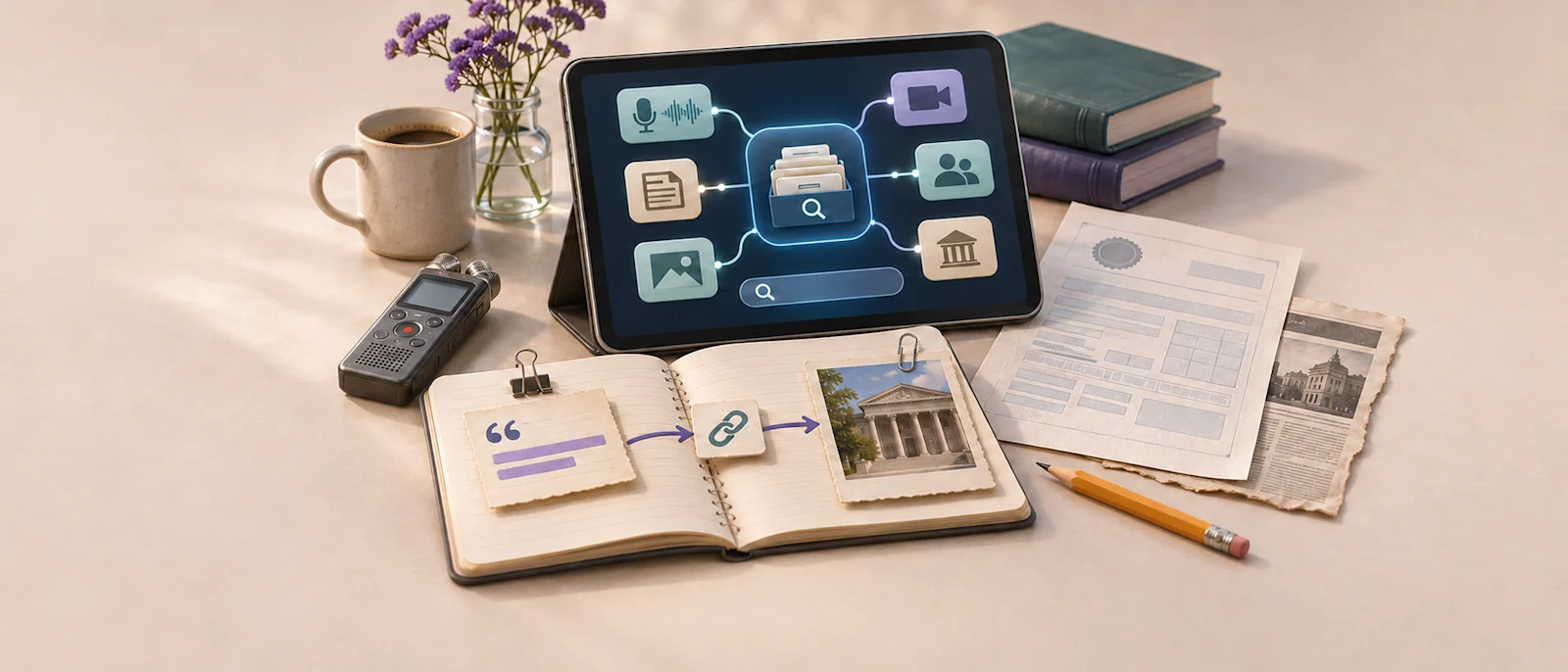
Researchers rarely work with one type of information. They collect papers, PDFs, notes, web sources, technical documentation, screenshots, reports, and other reference material.
The problem begins when that information needs to become useful again.
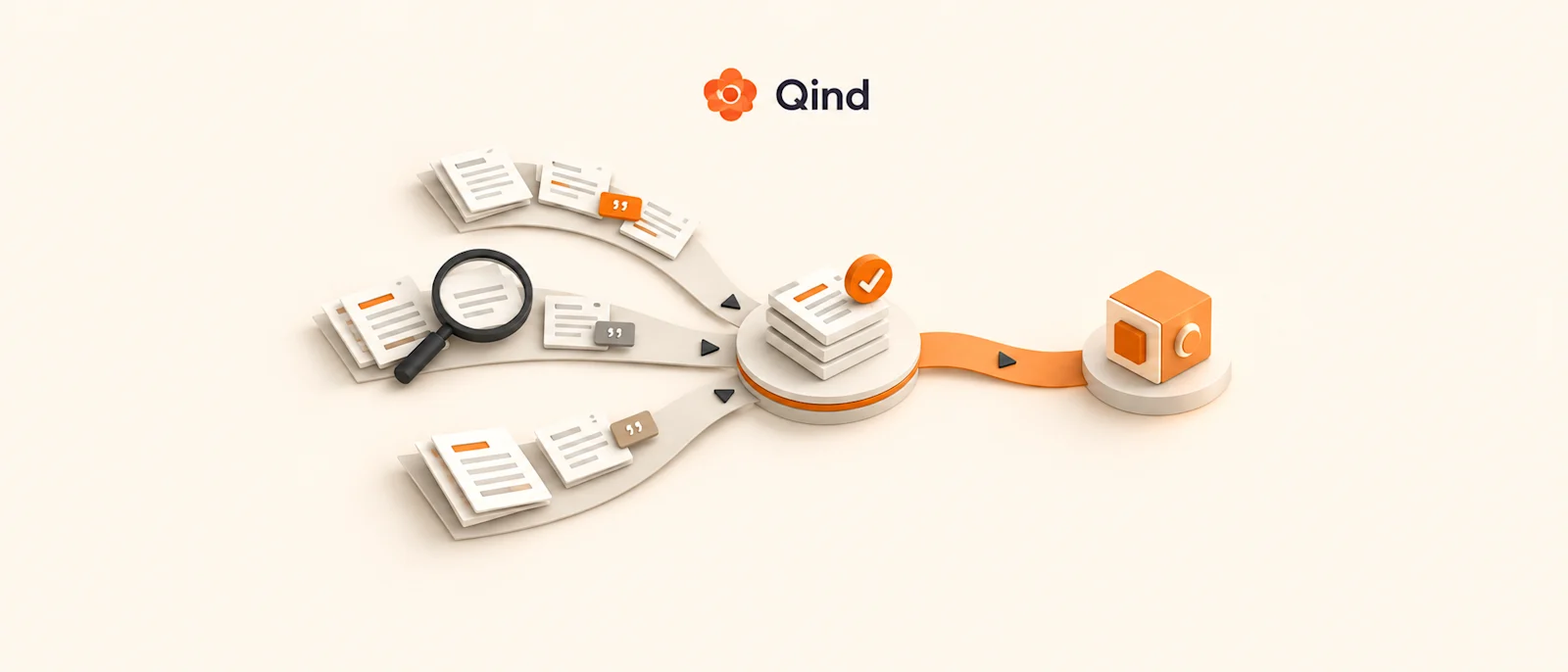
Qind helps bring research material into a searchable context so researchers can retrieve, question, and reconnect information without manually rebuilding the entire research trail every time.
The important shift is from storing sources to building research memory.
Instead of asking:
“Where did I save that paper?”
The researcher can move toward questions such as:
“What evidence have I already collected about this problem?”
That is a much more valuable starting point.
The Future of Research Is Not More Information
Researchers already have more information than they can realistically consume.
That trend will continue.
More papers will be published. More reports will appear. More technical content will be generated. AI will make content production even faster.
The advantage will not come from collecting the largest number of documents.
It will come from being able to understand what has already been learned.
Researchers who can preserve context, connect evidence, retrieve past reasoning, and recognize contradictions will move faster than those who repeatedly reconstruct their own research history.
The real challenge is no longer simply finding information.
It is building a system that remembers what the information taught you.