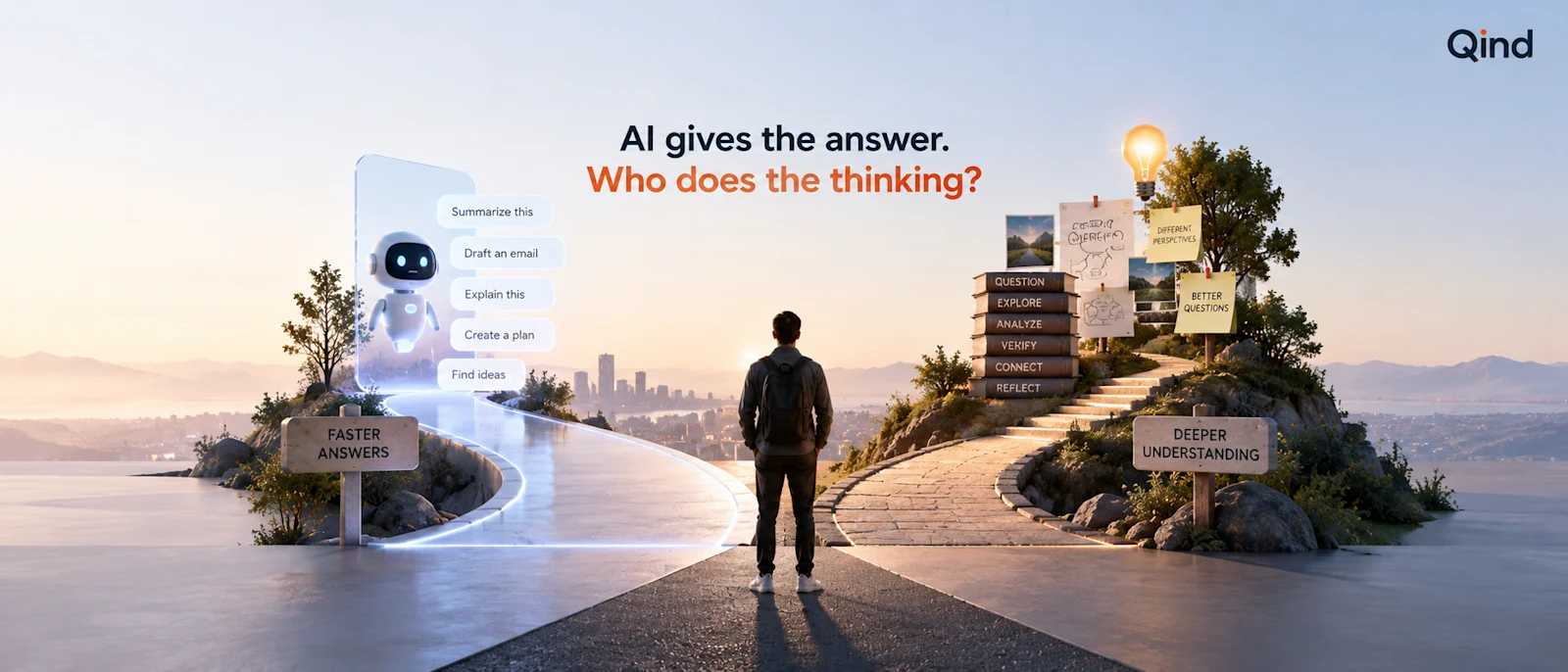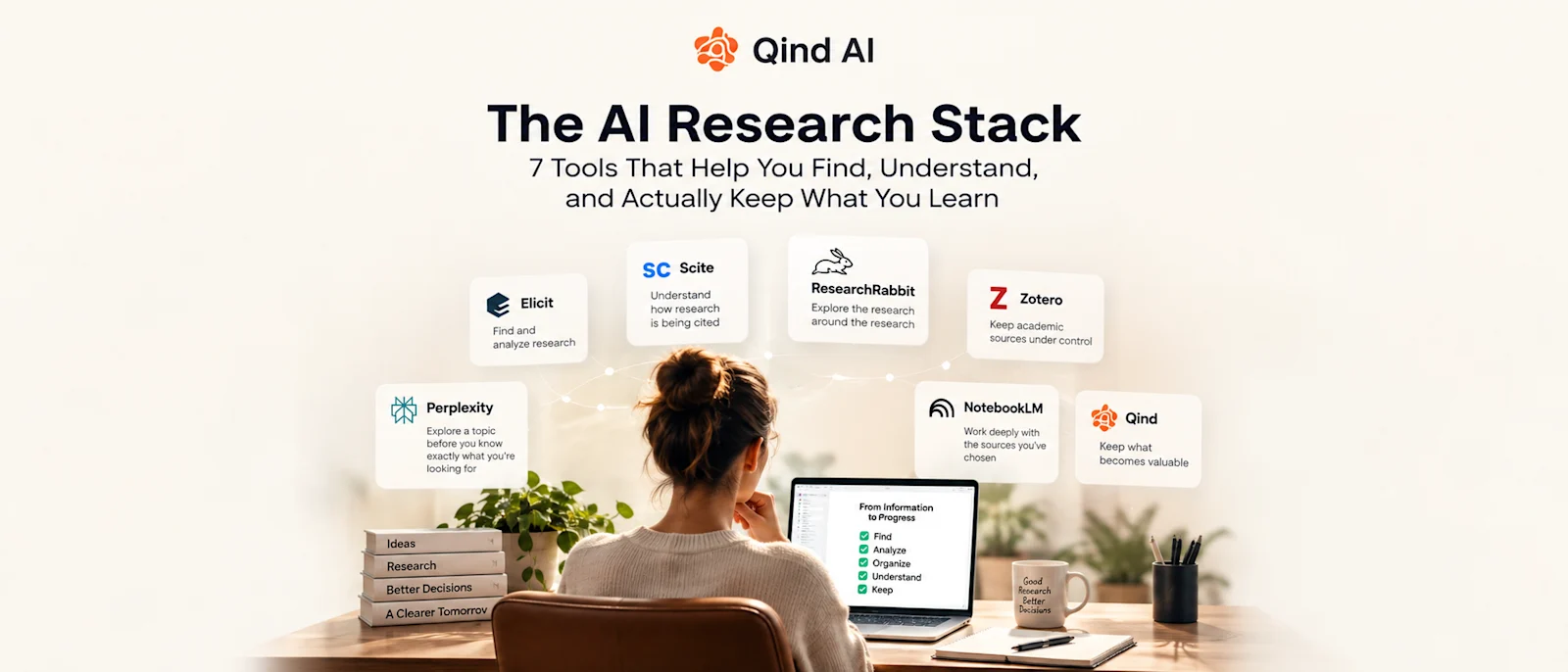
Generative AI has made one part of learning dramatically easier: getting an answer. A difficult paragraph can be explained in simpler language within seconds. A long chapter can be summarized before you finish your coffee. An unfamiliar concept can be turned into examples, analogies, flashcards, practice questions, or a personalized explanation almost instantly. For students and professionals trying to learn something new while managing everything else in their lives, that feels like an obvious improvement.
But learning has never been exactly the same thing as getting the answer. Sometimes the frustrating parts of learning — trying to remember, struggling with a problem, writing something in your own words, making a mistake and correcting it — are not obstacles around the learning process. They are part of the learning process itself.
That creates an uncomfortable question for the AI era. If a tool can remove much of the effort involved in understanding something, does that help us learn faster, or does it occasionally remove the very effort that makes learning last?
Recent research suggests the answer is neither “AI is bad for learning” nor “AI is the perfect tutor.” What seems to matter far more is how AI is used and what role it plays in the learning process.
The Difference Between Performance and Learning
Imagine you are solving a difficult mathematics problem with an AI assistant beside you. You get stuck, ask for help, and receive the solution. With that assistance, you solve the problem correctly. From the outside, your performance improved.
Now remove the AI and give you a similar problem tomorrow.
Can you still solve it?
That second question measures something different. Performance describes how well you can complete a task while assistance is available. Learning describes what remains when the assistance disappears.
The distinction is important because AI can make us look dramatically better at a task before we have actually developed the underlying skill. A calculator can help someone arrive at the right number without teaching them the mathematics behind it. In the same way, an AI system can produce a good answer without guaranteeing that the user could reconstruct the reasoning independently.
A Large Math Experiment Found Exactly This Problem
A particularly revealing study published in PNAS examined nearly 1,000 high-school mathematics students using GPT-4-based tutors. Researchers compared students using a standard AI interface, students using a specially designed AI tutor with educational guardrails, and students who worked without generative AI assistance.
During AI-assisted practice, the results looked impressive. Students using the standard GPT interface performed around 48% better than the control group, while students using the carefully designed GPT Tutor performed around 127% better. If the study had stopped there, it would have looked like overwhelming evidence that generative AI dramatically improves learning. DOI
But then the researchers removed the AI.
On a subsequent unassisted exam, students who had used the standard GPT interface performed about 17% worse than students in the control group. The students who had used the educationally designed GPT Tutor did not show that same decline; their performance was statistically similar to the control group. The researchers found that students using the standard system often treated it as a shortcut to solutions, while the guarded tutor encouraged more meaningful interaction through teacher-designed hints and guidance. DOI
That is a remarkable result because it separates two things we often accidentally treat as the same.
AI improved performance while AI was available.
It did not necessarily improve learning after AI was removed.
Students May Not Realize When This Is Happening
Perhaps the most interesting part of the mathematics study was not only the performance difference. Students themselves did not accurately perceive what had happened.
Those using the standard GPT system did not report feeling that they had learned less, even though their later unassisted performance declined. Likewise, students using the guarded tutor felt that their later performance had improved even though the researchers did not find a statistically significant improvement over the control group in the unassisted exam. DOI
This matters because learning often feels different from learning effectively. An explanation that arrives instantly can create a powerful feeling of clarity. You read it, understand every sentence, and think, “Yes, that makes perfect sense.” But recognition is easier than recall, and understanding something while the explanation is visible is not necessarily the same as being able to reconstruct it independently later.
AI can therefore make learning feel smoother while hiding whether anything durable has actually been built.
Another Experiment Found a Similar Pattern With Reading
A 2026 study in Computers & Education examined 405 students aged 14 to 15 across seven schools in England. Students studied text passages using different approaches: traditional note-taking, LLM assistance, or a combination of the two. Researchers then tested both comprehension and retention three days later. ScienceDirect
Students who took notes, either alone or alongside the LLM, performed significantly better on comprehension and retention than students who used only the LLM. Yet most students preferred using the LLM and perceived it as more helpful. In interviews, they described AI as useful for making complex information easier to understand and reducing cognitive load, while note-taking encouraged deeper engagement and memory. ScienceDirect
The result is not an argument against AI. In fact, one of the strongest-performing approaches combined AI with traditional learning activity. The important distinction is that AI was most useful when it supported active learning rather than replacing it.
Easy Understanding Can Be Deceptive
There is a reason AI explanations feel so effective. Good language models are excellent at turning complexity into fluent language. They can adapt an explanation, generate examples, simplify terminology, and answer follow-up questions without making the learner feel embarrassed for not understanding something the first time.
That is genuinely valuable.
But fluency creates a subtle risk. When an explanation is extremely easy to follow, we can mistake processing fluency for mastery. The information feels familiar because it was explained clearly, but the brain may not have performed enough retrieval, generation, comparison, or reconstruction to make the knowledge durable.
This is why someone can finish a beautifully explained tutorial feeling confident and then struggle when asked to perform the task without the tutorial open.
Learning Often Requires Productive Struggle
Education researchers have long used ideas such as “desirable difficulties” to describe the counterintuitive fact that some forms of effort can improve long-term learning. Retrieving an answer from memory, trying a problem before seeing the solution, spacing practice over time, or explaining a concept yourself can feel harder than simply rereading an explanation, but that difficulty can strengthen memory and understanding.
AI can remove many of these difficulties almost instantly.
That is sometimes exactly what we want. If you are blocked because a textbook explanation is unnecessarily confusing, asking AI for another explanation can help you continue learning rather than giving up. But if you ask AI for the answer before attempting the problem, the system may remove the productive struggle instead of the unnecessary friction.
The difference is subtle. One use of AI helps you climb the hill. The other quietly carries you over it.
Long-Term Retention Raises Similar Concerns
Another randomized controlled study published in 2025 followed 120 undergraduate students learning material about artificial intelligence. Students were assigned either to study with ChatGPT assistance or to use traditional non-AI methods. Forty-five days later, researchers gave them a surprise retention test.
Students in the traditional-learning group scored 68.5% on average, compared with 57.5% among students who had used ChatGPT. The researchers interpreted the difference as evidence that unrestricted AI assistance may reduce some of the cognitive effort involved in forming durable memories. DOI
One study should not be treated as a final verdict on AI and memory. Different subjects, prompts, learners, tools, and teaching designs can produce very different results. But combined with other experimental findings, it strengthens an important warning: making learning easier in the moment does not automatically make learning stronger over time.
But AI Can Also Be an Extremely Effective Teacher
If the story ended there, the conclusion would be easy: AI makes students dependent, so keep it away from learning.
The evidence does not support such a simple conclusion.
A 2025 randomized controlled trial at Harvard compared an AI-powered tutor with traditional in-class active learning in an undergraduate physics course. The custom tutor was specifically designed using established educational principles rather than functioning as a generic answer bot. Students using the AI tutor learned more in less time, reported higher engagement, and felt more motivated than students receiving the active-learning classroom instruction. DOI
That finding changes the question completely. AI itself is not necessarily the problem. The design of the interaction matters.
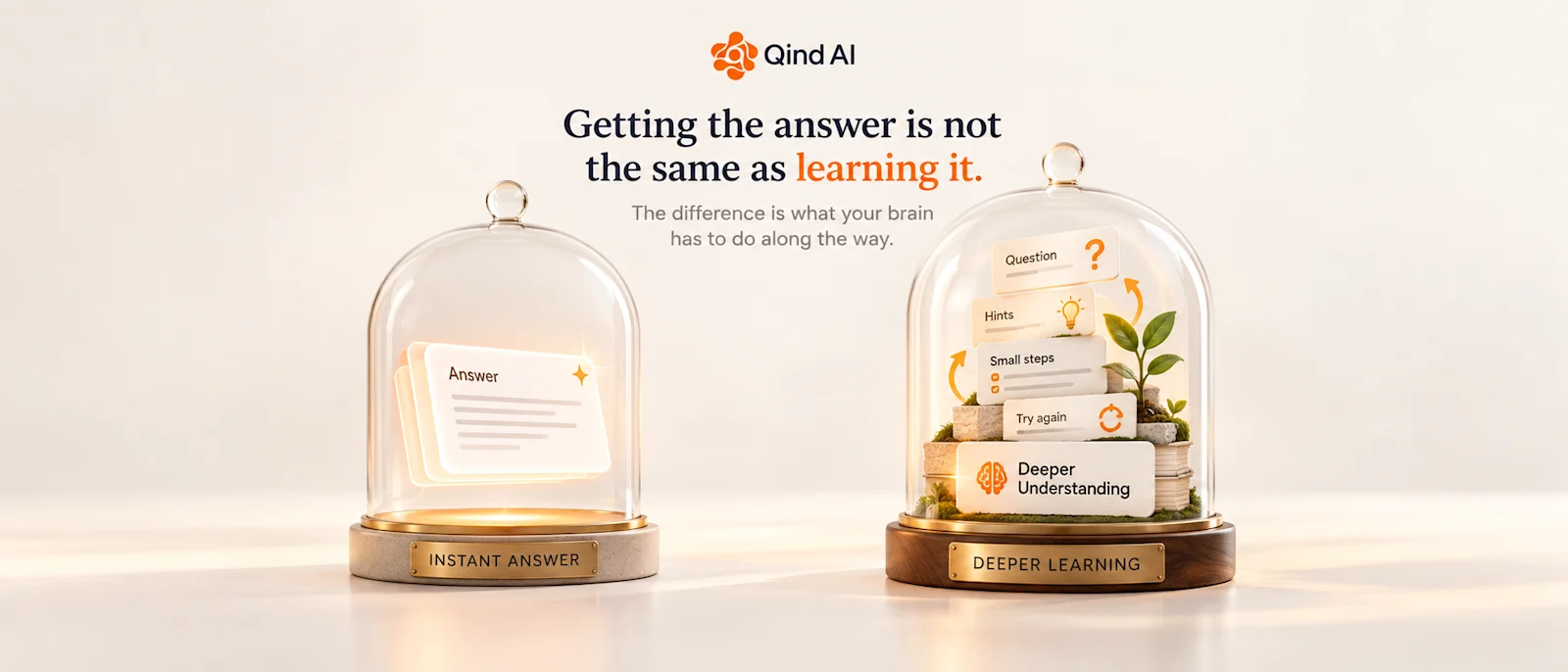
An AI that immediately provides solutions can bypass learning. An AI that asks questions, gives hints, adapts explanations, identifies misunderstandings, and makes the learner actively participate can create a very different experience.
The Best AI Tutor May Be the One That Refuses to Give You the Answer
This feels strange because we usually judge AI tools by helpfulness. If we ask a question and the system refuses to provide the answer immediately, it can feel worse than a tool that instantly solves the problem.
For learning, however, the apparently less helpful system may sometimes be the better one.
Imagine asking an AI to solve a programming problem. One assistant responds with finished code. Another asks what you have tried, points out the part where your reasoning breaks, gives you a hint, and asks you to attempt the next step yourself. The first assistant gets you to the answer faster. The second may help you become better at programming.
The PNAS mathematics experiment demonstrates this difference particularly well. The guarded GPT Tutor was designed using teacher-provided solutions and hints, which encouraged students to work with the system rather than simply copy answers. That design largely eliminated the negative effect seen when students later worked without AI. DOI
How You Prompt AI Changes What You Learn
This means learners have more control over the problem than it may initially appear.
Compare these two prompts:
“Give me the answer and explain it.”
and:
“Don’t give me the answer yet. Ask me questions and give me one hint at a time until I can solve it.”
Both use the same underlying technology, but they create very different cognitive experiences. The first optimizes for task completion. The second optimizes for learning.
For a difficult topic, you can ask AI to quiz you instead of summarizing it. You can ask it to challenge your explanation instead of writing one for you. You can attempt an answer first and ask the AI to identify gaps afterward. You can ask for examples only after trying to create your own.
The tool does not need to change for the learning process to change.
The First Attempt May Be More Important Than the Final Answer
One simple habit can preserve much of the value of AI without allowing it to replace your reasoning: attempt the task before asking for help.
Try to summarize the article yourself before requesting an AI summary. Write down what you think a concept means before asking for an explanation. Attempt the mathematics problem before requesting a hint. Sketch the structure of an essay before asking AI for an outline.
Your first attempt does not need to be good.
That is the point.
Once you have tried, the AI response becomes feedback rather than a substitute for the attempt. You can compare your reasoning, notice what you missed, and revise your understanding. The conversation becomes active rather than purely consumptive.
AI Is Excellent at Feedback
This may ultimately be one of AI's most important educational advantages.
Human feedback is expensive and often slow. A teacher cannot provide every student with unlimited one-to-one explanations at any hour of the day. A manager cannot review every practice attempt an employee makes while developing a new skill. An expert mentor cannot always be available exactly when someone becomes confused.
AI can.
It can review an explanation, create another example, identify gaps, generate a practice question, adapt the difficulty, or approach the same concept from a different angle within seconds.
Used this way, AI does not remove the learner from the process. It makes the learning loop shorter.
Attempt.
Feedback.
Revision.
Another attempt.
That is very different from asking for the finished product and moving on.
We Should Separate “I Need This Done” From “I Need to Learn This”
This distinction is especially important for knowledge workers.
Sometimes the goal really is task completion. If you already understand how to write a routine status update, there is little educational value in writing every sentence manually. If you understand spreadsheet formulas and simply need help constructing one quickly, using AI does not necessarily deprive you of meaningful learning.
Other times, the task is also training.
A junior developer working through a bug is not only fixing that bug. They are learning debugging. A new product manager writing a strategy document is also learning how to structure strategic thinking. A researcher interpreting a paper is building the judgment required to evaluate future papers.
If AI completes all of those tasks before the person struggles with them, the organization may gain short-term productivity while quietly reducing opportunities to develop expertise.
The question “Should I use AI here?” therefore depends partly on another question: Am I trying to finish this, or am I trying to become better at doing this?
This Matters Far Beyond Schools
Most discussions about AI and learning focus on students, but workplaces may face the same issue on a much larger scale.
Work has always been one of the places where people develop expertise. Junior employees become senior employees partly because they repeatedly solve difficult problems, make mistakes, review work, observe patterns, and build mental models through experience.
Now imagine that AI removes a large share of the entry-level cognitive work.
That might be extremely efficient today.
But what happens five years later when the organization needs senior employees who deeply understand the work that the AI helped them bypass?
This does not mean junior workers should be denied AI. It means companies may eventually need to design AI-assisted work with skill development in mind, rather than assuming that maximizing immediate productivity will automatically create future expertise.
The Productivity Paradox Becomes a Learning Paradox
This connects directly to the broader conversation about AI productivity.
AI can help someone finish a task faster today. But if the person learns less while completing it, they may become more dependent on AI tomorrow. The organization gains immediate output while potentially giving up some future independent capability.
On the other hand, an AI system that actively teaches while assisting can create the opposite effect. The employee gets help today and develops stronger capability for tomorrow.
The technology can support either path.
The design of the interaction determines which path becomes more likely.
The Goal Should Not Be to Protect Difficulty for Its Own Sake
None of this means learning needs to remain unnecessarily painful.
We should not force students to spend hours searching for information simply because previous generations had to. We should not make workers manually perform repetitive tasks purely in the hope that the repetition will build character. We should not reject tools that can explain something better than a textbook or provide personalized feedback faster than a teacher can.
The point is not to preserve friction.
It is to preserve engagement.
If AI removes the boring part while keeping the learner mentally involved, it can be an extraordinary educational tool. If it removes the thinking itself, the experience may become faster without becoming educational.
A Better Way to Use AI for Learning
A useful rule is to make AI the second participant in the learning process rather than the first.
Start with your own attempt. Then bring AI in to challenge, explain, quiz, compare, or provide feedback. Ask for hints before solutions. Request questions instead of summaries. Explain a concept to the AI and ask it to identify what you misunderstood. Return later and test yourself without assistance.
This approach deliberately preserves some cognitive effort while still taking advantage of what AI does exceptionally well.
The goal is not to prove that you can work without AI.
The goal is to make sure you can still think without it.
So, Does AI Help Us Learn?
Yes, it can.
Research shows that carefully designed AI tutoring can improve learning, increase engagement, and provide highly personalized support. But other experiments show that unrestricted AI assistance can improve immediate performance while reducing retention or independent performance later. DOI
Those findings are not contradictory. They point toward the same conclusion.
AI is not automatically a tutor.
Sometimes it is a shortcut. Sometimes it is an answer machine. Sometimes it is a feedback partner. Sometimes it genuinely teaches.
The difference depends on how the system is designed and how the learner chooses to use it.
The future of AI-assisted learning should therefore not be about removing as much effort as possible. It should be about removing the effort that does not help us learn while preserving the thinking, retrieval, experimentation, and struggle that do.
AI can help us reach the answer faster.
But when learning matters, reaching the answer is only half the job.