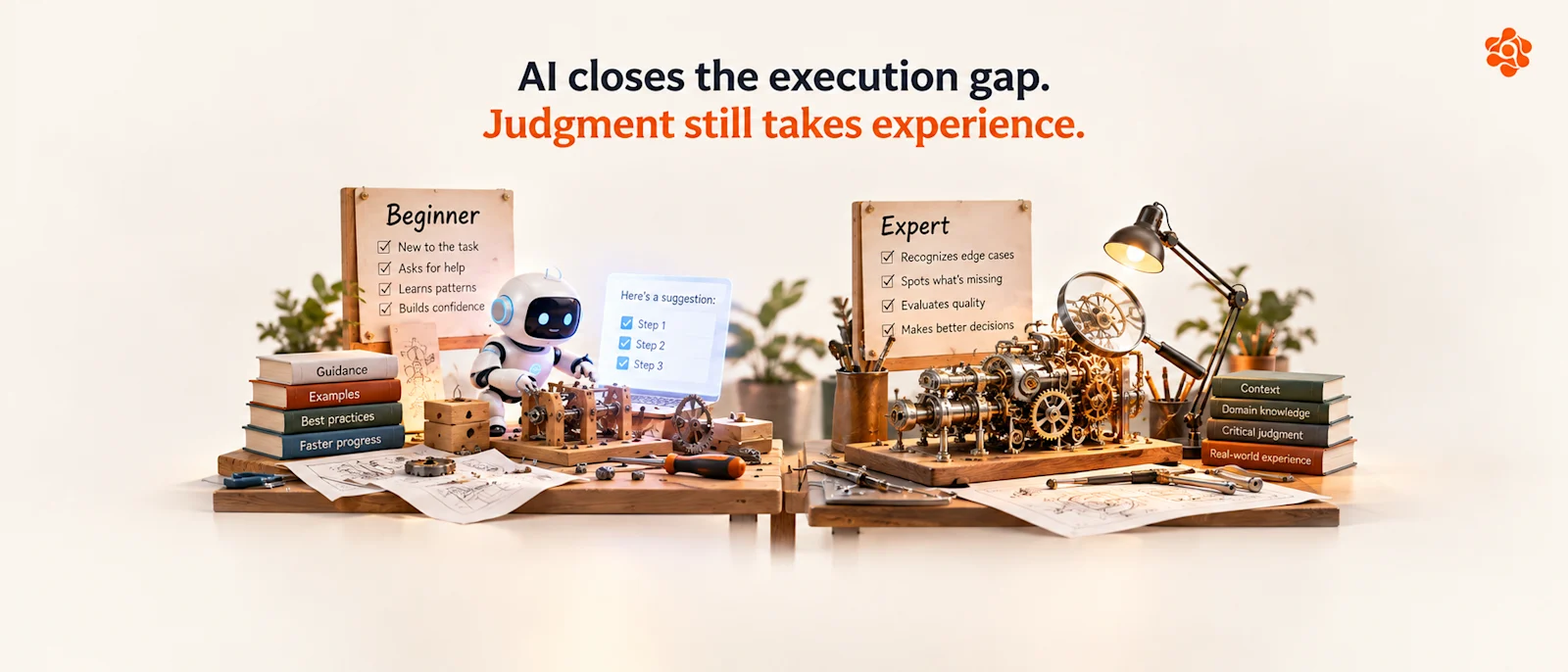
One of the most interesting patterns emerging from workplace AI research is also one of the least intuitive. Generative AI does not appear to help every worker equally. In several large field studies, the biggest gains have often gone to people with less experience, weaker baseline performance, or less familiarity with the task.
That does not mean experts stop benefiting from AI. It means the value of AI may depend partly on what the person already knows. For someone with years of experience, AI can accelerate parts of the workflow. For someone still learning the job, AI can do something more dramatic: it can provide access to patterns, language, and practical guidance that would otherwise take much longer to acquire.
This raises a bigger question about the future of work. If AI helps less experienced people close part of the gap with experts, does it make expertise less valuable? Or does it change what expertise is actually for?
The research suggests the second answer is much closer to reality.
A Study of More Than 5,000 Workers Found the Largest Gains Among Beginners
One of the strongest examples comes from a major study of 5,172 customer-support agents. Researchers examined what happened when workers gained access to a generative AI assistant that could suggest responses during live customer conversations. On average, AI increased productivity by about 15%, measured by the number of customer issues successfully resolved per hour. Stanford Graduate School of Business
The average result was interesting, but the distribution of that result was even more important. Less experienced and lower-skilled workers improved both the speed and quality of their work. The most experienced and highest-performing agents saw much smaller gains in speed, and in some cases small declines in quality. Stanford Digital Economy Lab
In other words, AI did not simply lift everyone by the same amount. It disproportionately helped people who had more room to improve.
That pattern suggests AI may act partly as a mechanism for transferring practical knowledge. Experienced workers have already built up internal patterns for recognizing customer problems, choosing effective language, and identifying which solutions are likely to work. Less experienced workers are still developing those patterns. AI can expose them to useful examples much earlier.
AI Can Compress the Learning Curve
This is one of the most powerful ways to think about generative AI at work.
A new employee traditionally learns through repetition. They handle cases, make mistakes, ask colleagues for help, watch how experienced people respond, and gradually build intuition. The process can take months or years because expertise is accumulated through many small experiences.
AI can compress part of that learning curve.
If the system has learned from large numbers of successful interactions, it can suggest language, approaches, or patterns that resemble what a more experienced worker might already know. The beginner does not suddenly possess the expert's judgment, but they gain access to something that previously required much more experience to encounter.
The customer-support research found evidence consistent with this idea. The AI did not merely make agents faster; the researchers also found signs that the tool facilitated worker learning and improved English fluency, particularly among international agents. Stanford Digital Economy Lab
That makes AI more than an automation tool. In some environments, it can function as a knowledge-transfer system.
Software Developers Show a Similar Pattern
The same general pattern appears in software engineering.
Randomized field experiments conducted across Microsoft, Accenture, and an anonymous Fortune 100 company studied 4,867 developers using AI coding assistance. When the results from the three experiments were combined, researchers found roughly a 26% increase in completed tasks among developers with access to the tool. Less experienced developers showed higher adoption and greater productivity gains. Microsoft
Again, the interesting point is not simply that coding became faster. The less experienced developers gained more.
That makes intuitive sense. A senior engineer already knows many of the syntax patterns, libraries, architectural approaches, and debugging strategies that an AI assistant may suggest. The AI can still save time, but it may be automating something the senior engineer already knew how to do efficiently.
A junior developer may encounter those same suggestions as something genuinely new. The tool is not only saving keystrokes. It may be exposing them to patterns they have not yet internalized.
The same AI response therefore has different value depending on the person receiving it.
Experts Already Carry Many of the Patterns AI Provides
Experienced workers have something beginners do not: compressed knowledge inside their own heads.
An experienced customer-support agent does not consciously reason through every sentence of every conversation. They recognize patterns quickly because they have seen similar situations before. A senior developer can often identify a likely bug category before carefully reading every line. An experienced product manager may hear a customer request and immediately recognize that the apparent feature request is actually evidence of a deeper workflow problem.
Expertise is partly the ability to turn many previous experiences into fast judgment.
Generative AI is powerful because it can reproduce some of those patterns on demand. For someone who has not yet developed them personally, that creates significant leverage. For someone who already possesses them, the difference may be smaller.
This is why asking whether “AI makes everyone 20% more productive” can be misleading. The effect depends heavily on the worker, the task, and where the task sits relative to the person's existing expertise.
The Best Workers May Have Less Routine Work Left to Improve
There is another reason experts may show smaller productivity gains: they may already be highly optimized.
Suppose an experienced support agent has spent years learning how to handle common customer problems efficiently. Their workflow already contains shortcuts, templates, intuition, and practiced language. There may simply be less obvious inefficiency for AI to remove.
A new agent, by contrast, might spend time searching documentation, thinking about phrasing, asking colleagues for confirmation, or hesitating between possible solutions. AI can remove much more of that friction.
This is sometimes called a ceiling effect. When someone is already performing near the upper end of what the task allows, there is less room for measurable improvement.
That does not mean AI becomes irrelevant to experts. It means the value may shift toward more complex tasks where the expert's existing advantage is smaller.
AI Can Expand What Non-Experts Are Able to Attempt
The effect becomes even more interesting when AI allows people to perform tasks that were previously outside their normal skill set.
BCG conducted a controlled experiment involving 480 generalist consultants and 44 data scientists. The study examined whether nontechnical consultants could use generative AI to complete technical data-science tasks. The general consultants were not data-science experts, but the AI-assisted group received access to GPT-4 with advanced data-analysis capabilities. Boston Consulting Group
The significance of this kind of result goes beyond productivity. AI does not only make an existing task faster. It can sometimes expand the range of tasks a person can attempt at all.
That changes the meaning of expertise in interesting ways. A nontechnical employee may be able to perform a first analysis without waiting for a specialist. A marketer may be able to explore data independently. A product manager may be able to prototype something that once required engineering support.
The boundary between “I cannot do this” and “I can make a useful first attempt” becomes much softer.
But Capability Is Not the Same as Expertise
This is where the interpretation becomes important.
If AI allows a beginner to produce work that looks much more expert, it is tempting to conclude that expertise itself is becoming less important. But producing expert-like output and possessing expert judgment are not the same thing.
An AI-assisted beginner may be able to generate a sophisticated analysis. An expert is more likely to know when the analysis is misleading.
A junior developer may produce functioning code. A senior engineer is more likely to recognize that the implementation creates a maintenance problem six months from now.
A new consultant may create an impressive strategy deck. An experienced consultant may notice that the recommendation relies on an assumption the client will never accept.
AI can help people reach a higher level of output faster. Expertise becomes especially valuable when deciding whether that output deserves to be trusted.
The “Jagged Frontier” Makes Expertise More Important in the Wrong Places
Research with Boston Consulting Group consultants provides a useful framework for understanding this. In a preregistered experiment involving 758 consultants, researchers studied how GPT-4 affected realistic consulting work. For tasks that fell within AI's capabilities, consultants using AI completed 12.2% more tasks, worked about 25% faster, and produced higher-quality results. DOI.org
But the researchers described AI capability as a “jagged technological frontier.” AI can be excellent at one task and surprisingly weak at another task that appears very similar. On tasks beyond that frontier, relying on AI could reduce performance. DOI.org
This creates a new expert advantage.
The most valuable person is not necessarily the one who can manually perform every task faster than AI. It may be the person who can recognize when AI is operating inside its strengths and when it has crossed into territory where its answers become unreliable.
That judgment is difficult to automate precisely because it depends on understanding the domain well enough to notice when something feels wrong.
Beginners Gain Speed. Experts Provide Calibration.
This suggests a useful division of labor.
AI can help beginners reach competent output much faster. Experts can help determine whether that output is actually good.
The beginner asks, “Can I produce this?”
The expert asks, “Should this be produced this way?”
That second question becomes increasingly important as AI lowers the cost of producing plausible answers.
When the cost of creation approaches zero, evaluation becomes more valuable. When anyone can generate a strategic plan, understanding which plan fits reality becomes the scarce skill. When anyone can generate code, knowing what belongs in a production system becomes more important. When anyone can produce analysis, knowing whether the analysis rests on valid assumptions becomes the differentiator.
AI democratizes production.
It does not automatically democratize judgment.
Expertise May Become Less About Recall
This could also change what we expect experts to remember.
In many professions, expertise has historically included a huge amount of memorized information. A developer knew syntax and APIs. A lawyer remembered cases and legal principles. A consultant knew frameworks. A doctor remembered diagnostic patterns. A researcher remembered literature.
AI makes some forms of recall much cheaper.
That does not make expertise disappear. It changes the value of the different components of expertise.
Knowing a fact may become less important than understanding how that fact fits into a larger system. Remembering syntax may matter less than recognizing a poor architecture. Recalling a framework may matter less than knowing when that framework is inappropriate.
In other words, expertise may move upward.
Less memory.
More judgment.
Less mechanical execution.
More interpretation.
Less “Do you know the answer?”
More “Do you know whether this answer makes sense?”
AI Could Make the Average Worker Better
There is an optimistic interpretation of all this.
If AI disproportionately helps people with lower baseline performance, then it may raise the floor of professional work. New employees could become useful more quickly. People working in a second language could communicate more effectively. Small teams could perform tasks that once required specialized departments. Expertise could become more accessible rather than concentrated among a small number of people.
The customer-support results are particularly encouraging from this perspective. Less experienced agents did not simply become faster; they also improved the quality of their work. Stanford Digital Economy Lab
That is very different from automation that merely replaces workers.
It suggests a model in which AI helps more people reach a higher baseline of capability.
But Raising the Floor Does Not Automatically Raise the Ceiling
There is also a less comfortable possibility.
If beginners rely too heavily on AI-generated expertise, they may perform better without developing the deep understanding that traditionally comes from doing the work themselves. The output improves faster than the underlying judgment.
That creates a long-term question organizations will need to confront.
Where do tomorrow's experts come from if today's beginners increasingly outsource the experiences through which expertise is built?
A junior employee becomes senior partly by working through difficult cases. A developer learns architecture partly by making design decisions and seeing their consequences. A manager develops judgment partly by making choices under uncertainty and discovering which assumptions were wrong.
If AI handles too much of that experience, short-term productivity could come at the expense of long-term skill development.
The research on productivity does not yet give us a complete answer to that question, but it is becoming one of the most important issues in AI-assisted work.
The Best Use of AI May Change as You Become More Experienced
This means AI usage should probably evolve with expertise.
A beginner may benefit from explanations, examples, recommended approaches, and guided suggestions. AI can serve partly as a tutor.
An intermediate worker may benefit from feedback. Instead of asking AI what to do, they can try first and ask the system to critique the result.
An expert may benefit most from expansion. AI can generate alternatives, search large spaces of possibilities, automate routine execution, or challenge the expert's assumptions.
The same tool serves different purposes at different stages.
Beginner: “Show me how.”
Intermediate: “Tell me what I missed.”
Expert: “Show me something I would not have considered.”
That progression preserves the productivity benefits of AI while reducing the risk that assistance becomes permanent dependence.
AI Is Not Flattening Expertise. It Is Redrawing It.
The idea that AI will simply make experts unnecessary misunderstands where expert value comes from.
Some parts of expert work are becoming easier to reproduce. Writing polished language, recalling common patterns, generating options, and completing familiar technical tasks can increasingly be assisted by AI.
But other parts become more important precisely because those outputs are easier to generate. Choosing the right problem, noticing flawed assumptions, understanding context, recognizing edge cases, judging trade-offs, and taking responsibility for consequences remain difficult.
If anything, cheap answers increase the value of people who know which answers deserve attention.
AI may therefore compress the gap between beginners and experts in execution while leaving a significant gap in judgment.
The Real Opportunity Is Knowledge Transfer
Perhaps the most important insight from the research is not that AI makes beginners faster. It is that AI may help distribute knowledge that used to remain trapped inside experienced workers.
Organizations have struggled with this problem for decades. Senior employees know how things really work, but transferring that knowledge is difficult. Documentation captures some of it. Training captures some of it. Mentorship helps, but experts have limited time.
AI systems trained or grounded on successful examples can make parts of that accumulated knowledge available exactly when someone needs it.
The less experienced employee receives guidance at the moment of work rather than six months later in a training session.
That can make expertise more scalable.
The challenge is making sure the AI transfers knowledge rather than simply replacing the need to learn it.
So, Why Does AI Help Beginners More?
Because beginners have more gaps that AI can fill.
They have fewer learned patterns, less accumulated experience, more uncertainty, and more time-consuming search and trial-and-error in their workflows. AI provides language, examples, suggestions, and solutions that more experienced workers often already carry internally.
That can produce dramatic productivity gains.
But the effect does not imply that expertise is becoming obsolete. It suggests something subtler: AI is becoming very good at distributing the visible outputs of expertise, while the deeper parts of expertise — judgment, calibration, context, and knowing when the obvious answer is wrong — remain difficult to transfer.
The future workplace may therefore look less like experts versus AI and more like a continuous ladder of AI-assisted capability.
Beginners reach competence faster.
Experts automate more routine work.
And the highest-value skill increasingly becomes knowing when the machine's answer is useful, when it is incomplete, and when it should be ignored.
AI may shrink the expertise gap.
But it also makes real expertise easier to recognize.