Generative AI can now write the first draft of an email, summarize a long document, explain an unfamiliar concept, generate a presentation outline, suggest code, and help us think through a problem before we have fully formed the question ourselves. For knowledge workers, that can feel like removing friction from dozens of small moments during the day. Instead of beginning with a blank page, we begin with something. Instead of searching through ten documents, we ask a question. Instead of struggling with the first explanation, we ask AI to give us one.
But removing friction raises an uncomfortable question. Some of the effort AI removes is tedious, repetitive, or genuinely unnecessary. Some of it, however, may be the effort through which we understand a problem, notice contradictions, develop judgment, and learn. If a machine increasingly performs the first stage of thinking for us, what happens to our own thinking over time?
The research does not support a simple answer like “AI makes us smarter” or “AI makes us stupid.” What it does suggest is more interesting: generative AI can reduce the amount of mental effort people invest in some tasks, but it can also move critical thinking into different parts of the workflow. The real issue may not be whether AI eliminates thinking, but which thinking we choose to outsource and which thinking we continue to own.
A Study of 319 Knowledge Workers Gives Us a Useful Starting Point
One of the most interesting studies on this question came from researchers at Microsoft and Carnegie Mellon University and was published at CHI 2025. The researchers surveyed 319 knowledge workers across different occupations and collected 936 real examples of people using generative AI in their jobs. Rather than testing whether participants could solve abstract logic problems, the study focused on how people themselves experienced critical thinking while using AI for actual work. Microsoft
The findings were not simply that people stopped thinking. Participants reported using critical thinking in roughly 60% of the AI-assisted work examples researchers collected. But the study also found an important relationship between trust and effort: greater confidence in the AI was associated with less critical thinking, while greater confidence in one's own ability was associated with more critical thinking. Microsoft
That difference matters because it suggests the central risk may not be AI use itself. The risk may appear when the user begins to assume that AI has probably handled the difficult part correctly and therefore has little reason to inspect the answer deeply.
Confidence Changes How Much We Think
Imagine two people receiving exactly the same AI-generated answer. One person knows the subject well and immediately notices that one assumption looks questionable. They check a source, adjust part of the answer, reject another section, and use only the pieces that make sense. The second person has less familiarity with the subject and sees a fluent, confident response that appears complete. They may have fewer reasons to challenge it.
The Microsoft study found a pattern consistent with this difference. When people had higher confidence in the AI, they tended to report less critical-thinking effort. When they had more confidence in their own expertise, they were more likely to engage critically with what the system produced. Microsoft
This creates a paradox. The people who may benefit most from AI assistance can sometimes be the same people who are least equipped to notice when the assistance is wrong. Expertise does not eliminate the usefulness of AI, but it gives the user something important: a reference point against which the output can be judged.
Critical Thinking Does Not Disappear. It Moves.
One of the most useful findings from the research is that AI appears to change the location of critical thinking inside a task. When people work without AI, much of the thinking may happen during production: planning what to write, constructing an explanation, finding evidence, or working through the problem itself. With AI assistance, some of that production can happen automatically.
The human role then shifts toward activities such as checking information, deciding what parts of an answer to use, integrating the output into a larger piece of work, and taking responsibility for the final result. The researchers described this as a shift toward information verification, response integration, and task stewardship. Microsoft
That is not necessarily less sophisticated work. In some cases, judging a proposed answer can require more expertise than producing a basic first draft. The danger appears when the user treats generation as completion and skips the verification and integration stages entirely.
AI Can Turn Creation Into Evaluation
Before generative AI, writing a report might require outlining the argument, deciding which evidence mattered, choosing a structure, writing the first draft, and revising it. With AI, it is possible to jump quickly to a plausible draft and begin from there. That can be a huge productivity improvement, particularly when the blank page itself creates unnecessary friction.
But producing and evaluating are different cognitive activities. Creating an argument forces you to decide what you believe before you see a polished answer. Evaluating an AI-generated argument asks you to react to a position that already exists. That starting point can influence what you notice, what alternatives you consider, and even which questions occur to you.
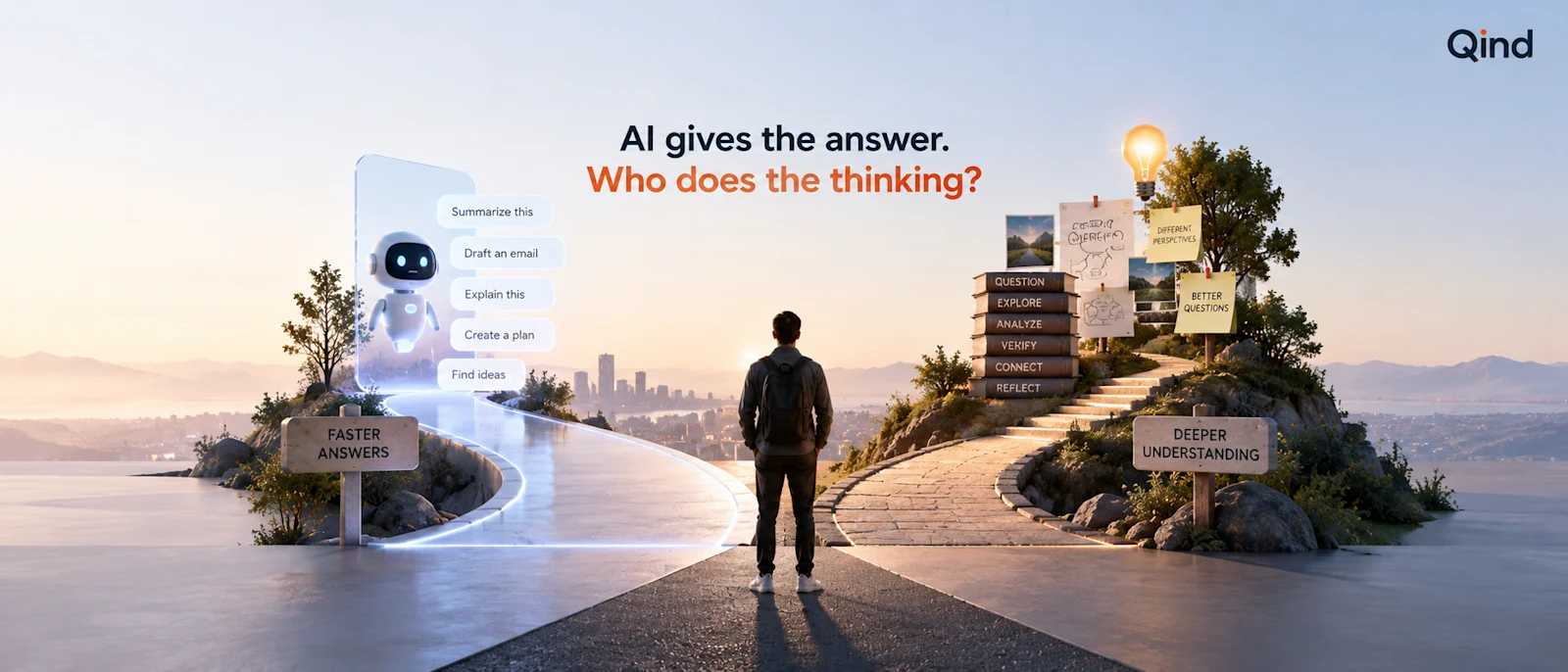
AI therefore does more than reduce typing. It can change the sequence in which thinking happens. Instead of moving from problem to reasoning to answer, we increasingly move from problem to AI answer to judgment. Whether that is beneficial depends heavily on how seriously we perform the judgment step.
The First Answer Has More Power Than It Looks
There is a psychological reason why this matters. Once a plausible answer is visible, it becomes an anchor. Even if we know intellectually that the answer may be incomplete, it can shape the direction of the conversation simply because it arrived first.
Suppose you ask AI for five explanations for declining user engagement. The system immediately gives you churn, poor onboarding, weak perceived value, competition, and notification fatigue. Those may all be sensible possibilities. But your investigation now begins inside the space defined by those five ideas.
Without that initial list, you might have framed the problem differently. You might have questioned whether engagement was even the right metric, looked at a different customer segment, or discovered an explanation that did not fit the obvious categories. The danger is not necessarily that the AI-generated ideas are wrong. It is that a good-looking first answer can quietly reduce the motivation to search for a very different one.
Convenience Can Hide Cognitive Work
Many forms of thinking feel inefficient while we are doing them. Struggling to remember something, trying to explain an idea in our own words, comparing conflicting evidence, and sitting with uncertainty can all be frustrating. AI offers a shortcut through many of those moments.
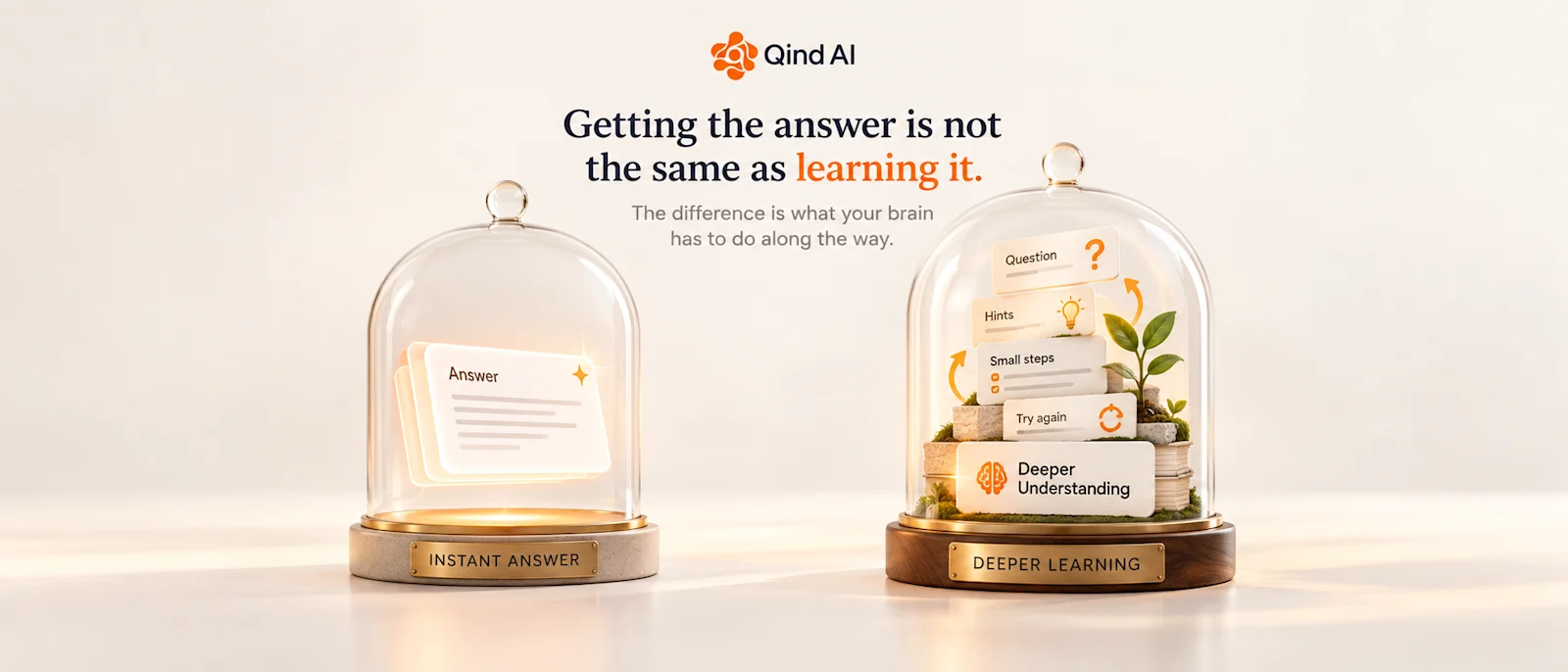
That shortcut is often useful. Nobody becomes more intelligent simply by spending twenty minutes searching for a fact that could be retrieved in twenty seconds. But not every difficult moment is wasted effort. Sometimes the difficulty is the mechanism through which understanding develops.
The challenge is learning to distinguish friction that contributes to learning from friction that merely consumes time. AI is excellent at removing both, but we may not always want both removed.
Understanding Something Yourself Is Different From Recognizing a Good Explanation
This difference becomes clear when you try to explain something without assistance. Reading a strong AI-generated explanation can create a powerful sense of familiarity. Everything seems logical, the structure is clear, and the conclusion makes sense.
Then someone asks you to explain the same idea from memory.
Suddenly the understanding feels much less complete.
Recognition and recall are different. Seeing a correct answer and agreeing with it is not the same cognitive process as reconstructing the idea yourself. This is one reason active learning techniques often require people to retrieve, explain, solve, or generate rather than simply reread polished material.
AI can make information feel understandable extremely quickly. The more difficult question is whether that feeling survives once the answer is no longer on the screen.
The Research Does Not Show That AI Is Making Everyone Less Intelligent
This is an important limitation because dramatic headlines can easily outrun what the evidence actually shows. The Microsoft study was based on self-reports from knowledge workers about their own AI-assisted tasks. It identifies relationships between confidence, perceived effort, and critical-thinking behavior, but it does not demonstrate that generative AI causes permanent cognitive decline or that people's intelligence deteriorates because they use it. Microsoft
The authors themselves frame the findings around changes in critical-thinking practices and effort, not a claim that human reasoning is disappearing. They also highlight opportunities to design AI systems that better support reflection, verification, and independent judgment. Microsoft
That distinction should shape how we talk about this topic. “AI is making us stupid” is a catchy headline. “AI changes where and how cognitive effort occurs, with risks when users over-trust the system” is less dramatic, but much closer to what the evidence actually supports.
Experts and Beginners May Experience AI Differently
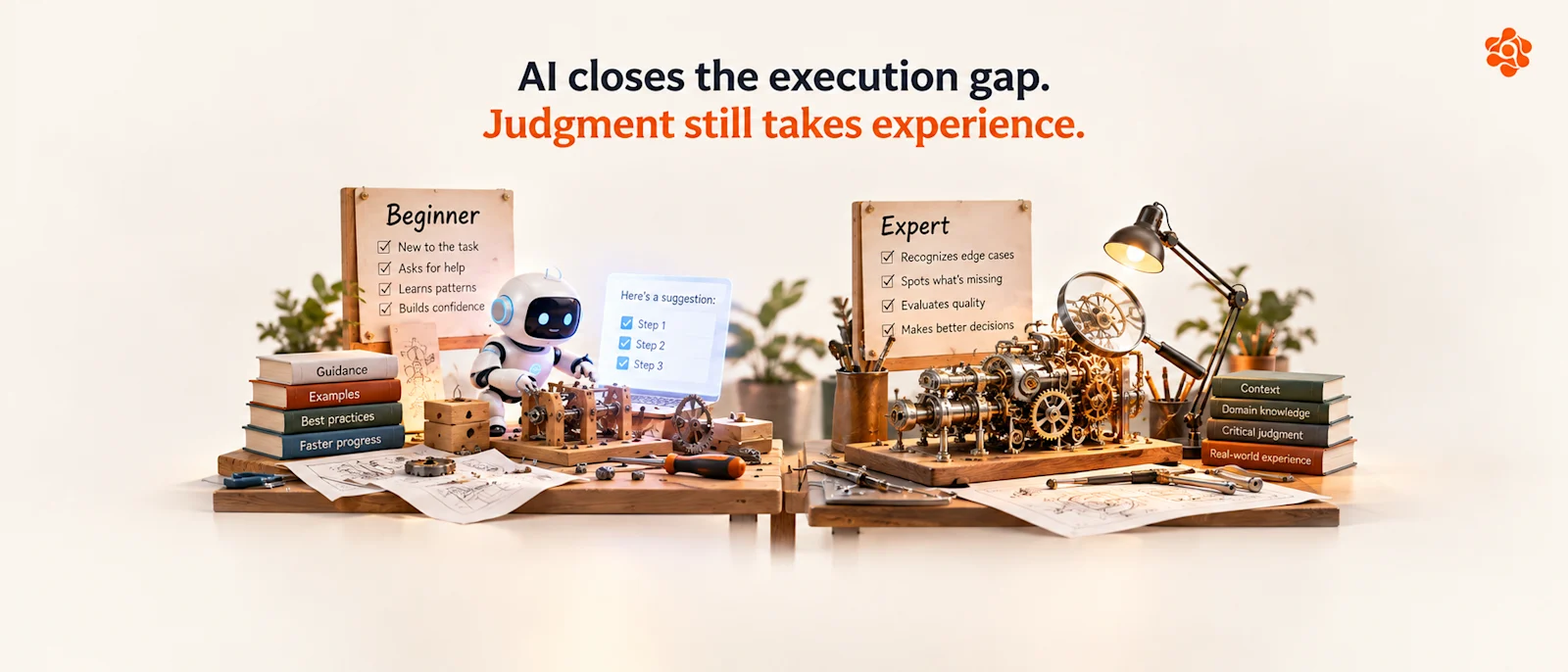
AI can be particularly powerful for someone entering an unfamiliar domain because it can provide explanations, terminology, examples, and starting points almost instantly. Instead of spending days trying to understand the basic landscape, a beginner can become conversationally familiar with a subject remarkably quickly.
But conversational familiarity can be deceptive. Knowing how to ask about a subject is not the same as developing the deeper mental models that allow experts to notice subtle errors, judge unusual cases, or recognize when a seemingly reasonable answer does not fit reality.
This makes AI both an accelerator and a potential trap for beginners. It can shorten the path toward competence, but only if the user continues developing enough independent understanding to evaluate what the system provides. Otherwise, the person may become highly capable at obtaining answers without becoming equally capable at judging them.
Good AI Use May Require More Metacognition, Not Less
There is another skill hidden underneath critical thinking: knowing when you need to think harder. Researchers often call this metacognition — thinking about your own thinking. In an AI-assisted environment, that skill becomes increasingly valuable because not every output deserves the same level of scrutiny.
A casual rewrite of a sentence may require very little verification. A medical interpretation, financial decision, research conclusion, production code change, or strategic recommendation deserves far more attention. The challenge is recognizing the difference before blindly accepting the convenient answer.
Microsoft researchers studying the cognitive demands of generative AI have argued that these systems create new metacognitive requirements for users. Instead of simply completing tasks, people need to decide when to rely on AI, when to question it, how to evaluate its output, and when independent reasoning is necessary. Microsoft
In that sense, using AI well may require a new kind of discipline. The goal is not to distrust everything the system says. It is to know when trust must be earned.
Verification Is Becoming a Core Knowledge-Work Skill
For many knowledge workers, verification used to happen after searching. You would find a source, assess its credibility, compare it with other information, and decide whether it deserved to influence your work. Generative AI changes that workflow because it can combine many ideas into a single fluent response.
Fluency creates convenience, but it can hide uncertainty. A response can contain several correct points, one unsupported claim, an outdated assumption, and a completely invented detail while maintaining exactly the same confident tone throughout.
This means verification is no longer an optional cleanup stage for high-stakes work. It increasingly becomes part of the core task. The question is not simply “Did AI give me an answer?” but “What would need to be true for this answer to be trustworthy?”
One Useful Habit: Think Before You Ask
There is a simple way to preserve more independent reasoning without giving up the benefits of AI: form an initial position before asking the system.
If you are solving a problem, write down your first explanation. If you are evaluating a strategy, identify the factors you think matter. If you are reviewing a bug, create a hypothesis before asking AI for possible causes. If you are brainstorming, generate a few ideas yourself before requesting twenty more.
Then use AI as a comparison.
This changes the interaction from “Tell me what to think” into “Challenge what I currently think.” The AI response can reveal missing possibilities, expose weak assumptions, and expand the search space without completely replacing your first attempt at reasoning.
The purpose is not to prove that humans should always think first. It is to prevent convenience from turning into automatic cognitive delegation.
Another Useful Habit: Ask AI to Disagree With You
Most people naturally use AI to help complete a task. Fewer people deliberately use it to create intellectual resistance.
After developing an idea, ask what evidence would contradict it. Ask for the strongest argument against your conclusion. Ask which assumptions are unsupported. Ask what an expert from a different discipline might notice. Ask what would have to be true for your plan to fail.
This turns AI from an answer machine into a tool for expanding the range of perspectives considered. Microsoft Research has explored similar ideas through its broader “Tools for Thought” work, including systems designed to introduce alternative viewpoints rather than merely automate existing cognitive tasks. Microsoft
The difference is subtle but important. Instead of outsourcing thinking, you use AI to create more things worth thinking about.
The Goal Is Not Maximum Cognitive Effort
There is also a danger in romanticizing difficulty. We should not deliberately make every task harder simply because effort can sometimes support learning. Calculators did not destroy mathematics, search engines did not make all research meaningless, and spellcheck did not eliminate writing ability.
Human cognition has always depended on tools. We write things down because memory is limited. We use spreadsheets because mental arithmetic does not scale. We use search because no individual can memorize the internet. Generative AI is another step in that history of cognitive assistance.
The important question is not whether a tool reduces effort. Good tools are supposed to reduce unnecessary effort. The question is whether the effort being removed was contributing something valuable to understanding, judgment, creativity, or learning.
AI Should Take Over the Work You Do Not Need to Learn
This gives us a practical distinction. Some tasks are valuable only because they need to be completed. Others are valuable partly because performing them develops knowledge or judgment.
If you already understand how to write a routine meeting summary, letting AI produce the first version may save time without costing much. If you are learning how to analyze scientific research, outsourcing the entire reasoning process may remove precisely the practice you need. If you already know a programming language deeply, AI-generated boilerplate may be harmless acceleration. If you are learning the language, generating every solution before attempting one yourself can create a very different learning experience.
The correct amount of AI assistance therefore depends partly on your goal. Are you trying to finish the task, or are you trying to become better at the task?
The Future Skill May Be Knowing What Not to Outsource
The conversation about AI skills often focuses on prompting: how to ask better questions, provide useful context, structure instructions, and get stronger outputs. Those skills matter, but they may become less distinctive as AI systems improve and require less careful prompting.
A more durable skill may be deciding what deserves human attention.
Which judgment should remain yours? Which parts of the task should you struggle with because the struggle builds expertise? Which answer deserves independent verification? When should AI provide a first draft, and when should it provide a second opinion?
Those choices determine whether AI becomes a replacement for thinking or an extension of it.
So, Does AI Make Us Think Less?
Sometimes, yes.
Research suggests that greater confidence in generative AI is associated with lower reported critical-thinking effort in AI-assisted work, and knowledge workers themselves describe situations where the technology reduces the amount of cognitive effort required. At the same time, the same research shows that critical thinking often continues in different forms, particularly through verification, integration, and responsibility for the final result. Microsoft
That means the better question is not whether AI makes humans think less in every situation. It is whether we are using the mental capacity AI frees up for deeper judgment or simply allowing the machine's first answer to become our final answer.
AI can remove the blank page, the repetitive search, the routine draft, and much of the mechanical effort surrounding knowledge work. That can be enormously valuable. But there are parts of thinking we should be careful not to optimize away: forming our own hypotheses, noticing contradictions, sitting with uncertainty, changing our minds, and deciding what deserves to be believed.
The future of intelligent work may not depend on how much thinking AI can do for us. It may depend on how carefully we decide which thinking remains ours.