AI Is Saving Us Time. So Why Are We Still So Busy?
Generative AI was supposed to give us time back. That promise made immediate sense. If AI can draft emails, summarize meetings, write first versions of documents, analyze information, and help us search faster, then the logical result should be fewer hours spent on routine work. In many cases, that part is already happening. Research from Microsoft found that knowledge workers using generative AI spent less time on email and completed documents faster, while a large study of customer-support agents found meaningful productivity gains from AI assistance.And yet the everyday experience of work often does not feel dramatically lighter. People are still busy. Calendars are still full. Slack and Teams are still noisy. The inbox still refills. Deadlines have not disappeared. In many organizations, the time AI saves on one task seems to be absorbed almost immediately by another. So a more interesting question is emerging: if AI is genuinely helping us work faster, why does work still feel so full?
AI Is Already Saving Time on Real Work
It is important to begin with the part that is working. In a six-month randomized field experiment involving thousands of knowledge workers, Microsoft researchers found that people who actively used generative AI spent substantially less time on email and completed documents faster. In the revised NBER version of the study, frequent users spent roughly two fewer hours on email per week, and the researchers also observed less work outside regular hours among those users.That is not a hypothetical productivity gain. It is time. Other research points in the same direction. A large Stanford study of 5,172 customer-support agents found that access to generative AI increased productivity, measured by issues resolved per hour, by about 15% on average. The gains were especially strong for less experienced and lower-skilled workers, suggesting that AI can help transfer useful patterns and expertise more quickly.Software development shows similar evidence. Randomized trials across Microsoft, Accenture, and another Fortune 100 company found higher task completion among developers using an AI coding assistant, with particularly strong gains among less experienced developers. So the argument that AI can save time is becoming easier to support. The harder question is what happens to that saved time afterward.
Saved Time Does Not Automatically Become Free Time
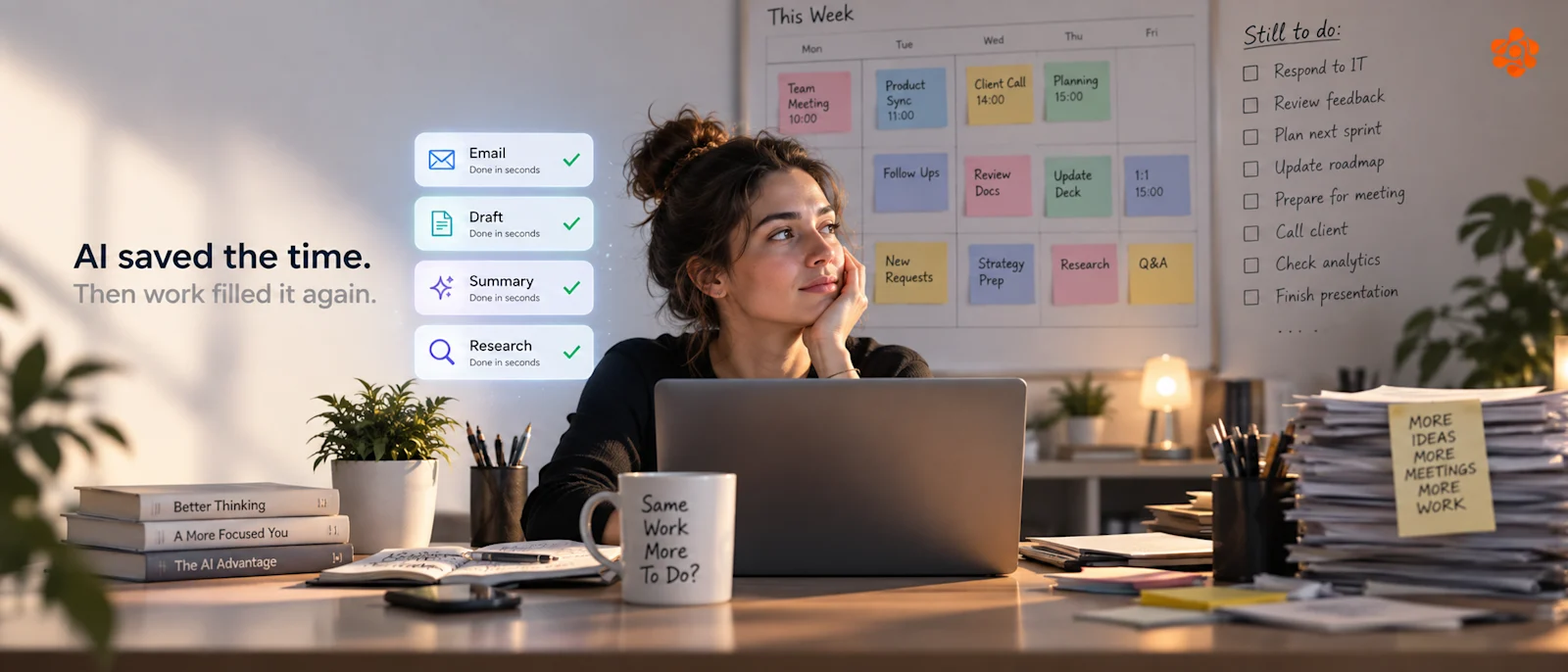
This is where productivity discussions often become too simple. Imagine a task that used to take sixty minutes and now takes forty. You have saved twenty minutes. But that does not mean you suddenly have twenty minutes of leisure.In most workplaces, the next task is already waiting. There is another document to review, another message to answer, another meeting to prepare for, another dashboard to check, another request from a colleague, or another project that was previously delayed because nobody had enough time to start it. The time saved at the task level gets reabsorbed at the system level.That helps explain why productivity can improve while the workday still feels dense. The organization does not necessarily respond to faster work by reducing the amount of work. It may simply increase throughput. You finish more, therefore more becomes possible.
Productivity Gains Often Expand Expectations
This is not unique to AI. When technology makes an activity cheaper or faster, people often do more of that activity instead of doing the same amount and stopping earlier. Email is a useful example. Digital communication made sending messages dramatically easier than writing and delivering physical letters. The result was not a world where people spent almost no time communicating. The result was vastly more communication.AI may create a similar dynamic. If writing a report takes half as long, perhaps teams start producing more reports. If summarizing research becomes nearly instant, people may review more sources. If creating a presentation becomes easier, the expected quality or frequency of presentations may rise. Efficiency reduces the cost of an action. It does not necessarily reduce demand for the action.
Research Is Starting to Show This Gap
A 2025 NBER study on AI adoption and work patterns found something especially interesting. Even as workers reported productivity benefits and organizations rapidly adopted AI chatbots, the researchers found little evidence of large changes in recorded earnings or hours worked in the early period they studied. The structure of work changed more clearly than the total amount of work. New tasks appeared around AI integration, content generation, and oversight.That distinction matters. AI may not simply remove work. It may rearrange it. A task that once consisted of writing from scratch may become prompting, reviewing, correcting, integrating, and approving. A research task may shift from searching manually to evaluating machine-generated summaries. A coding task may move from producing every line to inspecting suggestions and reasoning about edge cases. The work changes shape. The workload may remain.
AI Can Remove Friction Without Removing Responsibility
This is one of the most important differences between automation and assistance. When a machine fully replaces a task, the human workload can disappear. When AI assists with a task, the human often remains responsible for the output.That means someone still needs to decide whether the AI response is correct, relevant, safe, complete, or appropriate. Someone still owns the final result. The writing may be faster, but review becomes more important. The search may be faster, but verification becomes more important. The analysis may be faster, but judgment still matters.This can create a strange feeling. The difficult mechanical part of the task gets easier, while the cognitive responsibility remains. You are producing faster, but you are also supervising more.
Faster Work Can Create More Work
Consider what happens inside a team when AI increases individual productivity. A product manager can produce a competitive analysis faster. A developer can complete a first implementation faster. A marketer can generate several campaign variations faster. A researcher can summarize a larger number of papers.Those improvements are real. But once everyone becomes faster, coordination needs may also increase. There are more drafts to review, more ideas to evaluate, more experiments to prioritize, more code to test, and more outputs to integrate.This may be one reason the Microsoft field experiment found meaningful reductions in email time but no significant change in time spent in meetings in the initial study. Meetings require coordination between multiple people. Individual productivity improvements are much easier to achieve than organization-wide coordination changes. AI can make one person's work faster. It cannot automatically make five people's calendars align.
The Bottleneck Moves
Every productivity tool solves one bottleneck and exposes another. Before AI, writing might have been the bottleneck. Now reviewing might be the bottleneck. Before AI, finding information might have been slow. Now deciding which information to trust may take more attention.Before AI coding tools, generating boilerplate may have consumed significant time. Now testing, architecture, and code review may become relatively more important. This is not failure. It is what productivity improvement often looks like. The constraint moves somewhere else.The problem begins when organizations continue measuring productivity as if the old bottleneck still exists.
More Output Is Not the Same as Better Work
If AI lets someone produce twice as many drafts, does that mean productivity doubled? Not necessarily. The real answer depends on whether those drafts were useful.Knowledge work is difficult to measure because output volume is often a poor substitute for value. Ten reports are not automatically better than five. Fifty ideas are not necessarily better than ten. A developer who generates more code may also create more complexity. A team that produces more documents can still make worse decisions.This is why AI productivity should not only be evaluated through speed. Speed matters. But quality, decision-making, clarity, accuracy, and downstream usefulness matter too. Otherwise, we risk optimizing for activity.
AI May Be Increasing the Supply of Work
There is another possibility that receives less attention. AI may make it easier to create work for other people.If creating a detailed proposal used to take two hours and now takes twenty minutes, more proposals can be created. Each proposal may require review from colleagues. If generating a data analysis becomes easier, more analyses can be requested. If writing specifications becomes faster, more projects can be proposed.The person using AI experiences a productivity gain. The people receiving the output may experience additional workload. This creates a productivity spillover problem. One person's saved time can become another person's inbox.
The Workday Has an Absorption Problem
Most organizations are extremely good at absorbing available capacity. If a team finishes something earlier than expected, another priority appears. If a process becomes more efficient, expectations adjust. If one employee becomes faster, their responsibilities may expand.This is rational from the organization's perspective. Unused capacity looks inefficient. But it means that productivity technology does not necessarily translate into a calmer working day. A company may receive the benefit as higher output. A customer may receive the benefit as faster service. The employee may receive very little of the saved time directly.One NBER paper examining AI exposure and time use even found evidence associated with longer workdays and reduced leisure in some settings, particularly where AI complemented human labor and increased marginal productivity. The authors argue that who captures the benefit of productivity gains depends partly on workplace and market conditions.That makes the phrase “AI saves time” incomplete. A better question is: who gets the time that was saved?
The Answer Depends on How Work Is Designed
Technology alone does not determine whether productivity gains produce more freedom or more output. Management practices matter. Team expectations matter. Incentives matter. Work culture matters.If an organization responds to AI efficiency by continuously increasing workload, employees may become more productive without feeling less busy. If saved time is deliberately redirected toward deeper work, learning, better decisions, or reduced after-hours work, the experience can be very different.The Microsoft field experiment provides a small but important example of this. In the later version of the study, active AI users not only spent less time on email but also reduced work outside normal hours. That suggests productivity gains can become real quality-of-life gains, but that outcome is not automatic.
We May Need to Redefine Productivity
For decades, workplace productivity has often been framed around output. How much did we produce? How quickly did we finish? How many tasks did we complete? AI makes those metrics easier to improve.The danger is that the metrics become less meaningful precisely because production becomes cheaper. When generating ten ideas takes almost no effort, “number of ideas generated” stops telling us very much. When drafting a document becomes trivial, document count becomes a weak productivity measure. When code generation accelerates, lines of code become even less useful than they already were.The scarce resource shifts from production to judgment. Which idea is worth pursuing? Which document contains the right conclusion? Which AI-generated solution is robust? Which task should not be done at all?
The Next Productivity Advantage May Be Doing Less
AI makes it easier to do more. That may not be the same as progress.The organizations that benefit most may eventually be the ones that use AI not simply to increase output, but to remove low-value work entirely. Does this meeting still need to happen? Does this report need to exist? Do five people need to review this document? Does this status update need to be written manually? Does anyone use this dashboard? Could this process disappear instead of becoming faster?These questions are less exciting than generating something with AI, but they may matter more. Saving five minutes on a task you should not be doing is less valuable than eliminating the task.
Busy Is Not the Same as Productive
This distinction becomes more important as AI spreads through knowledge work. A busy day can contain dozens of completed tasks and still produce very little meaningful progress. A productive day may involve solving one difficult problem, making one important decision, or finally understanding something that had been unclear for weeks.AI can help with both kinds of work. But organizations need to decide which one they are optimizing for. If every productivity gain becomes permission to add another task, another project, another message, or another meeting, AI will make us extraordinarily efficient at remaining busy.
So Why Are We Still So Busy?
The evidence increasingly suggests that AI can save meaningful time on specific tasks. It can reduce email burden, accelerate document creation, improve customer-support productivity, and help developers complete work faster. But task efficiency and workday efficiency are not the same thing.Saved time gets absorbed. Expectations rise. More output creates more review. Bottlenecks move. Coordination remains difficult. New AI-related work appears. And organizations often capture productivity gains by increasing what can be accomplished rather than reducing how long people work.That does not mean AI productivity is an illusion. It means we are asking technology to solve an organizational problem. AI can make work faster. Whether faster work creates a better workday depends on what we decide to do with the time it gives us.