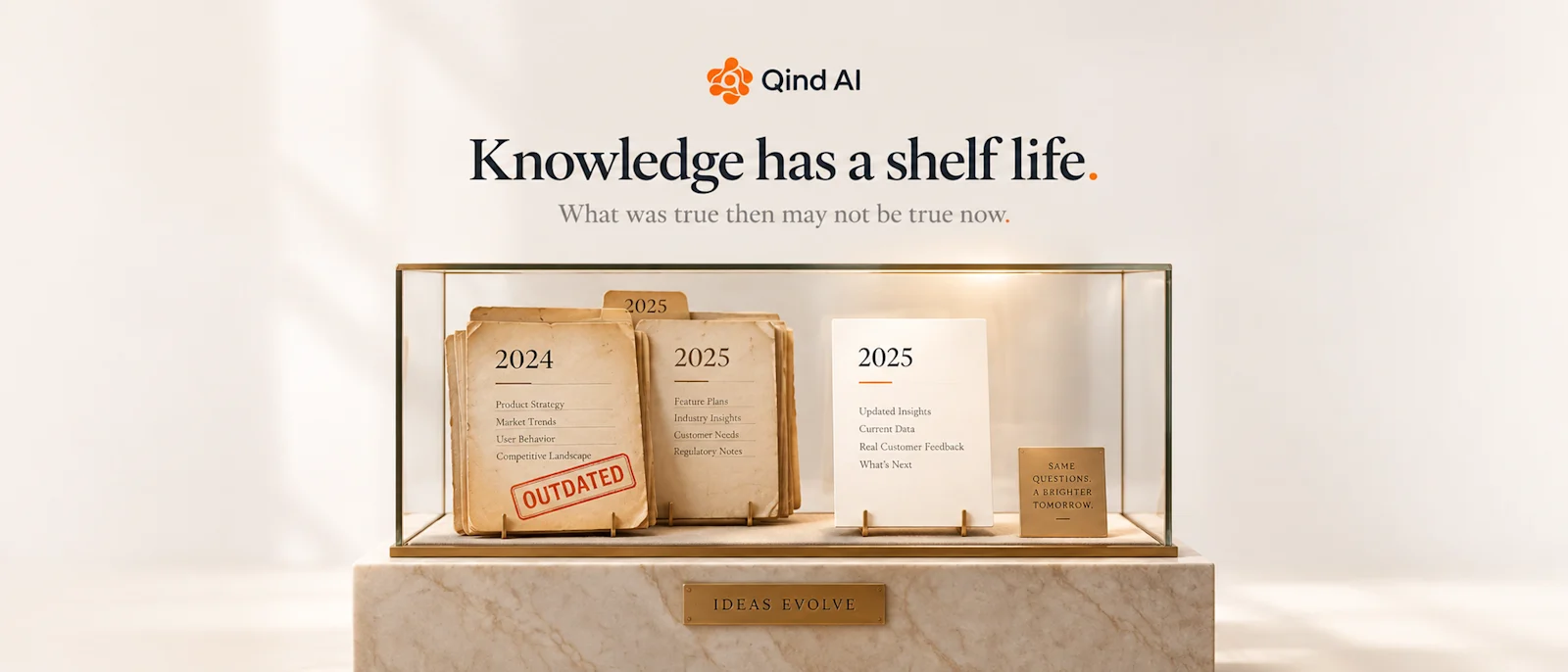
Most teams worry about losing knowledge. They worry that important decisions will disappear, useful research will be forgotten, or valuable insights will remain trapped in old documents. So they build knowledge bases, documentation spaces, internal wikis, note systems, and shared folders designed to preserve what the organization knows.
Preservation sounds like an obvious good. The problem is that knowledge does not stay correct forever.
A product strategy changes. A pricing assumption becomes outdated. A technical workaround is replaced. A market report no longer reflects reality. A customer segment behaves differently. A process that made sense six months ago becomes actively harmful after the organization changes.
The information is still there.
It is simply no longer true in the same way.
That creates a different kind of knowledge problem: not missing information, but expired information.
Old Knowledge Often Looks Exactly Like Current Knowledge
Outdated information rarely announces itself.
A document written two years ago can look just as polished as one written yesterday. An internal note may still contain confident language even though the assumptions behind it are no longer valid. A carefully documented process can continue circulating long after the team quietly stopped following it.
This is what makes stale knowledge dangerous. Missing information creates uncertainty. Outdated information creates false confidence.
When someone cannot find an answer, they know they need to investigate. When they find an answer that looks authoritative, they are much more likely to trust it.
The problem is not that the knowledge disappeared.
The problem is that it survived too well.
Documentation Has a Half-Life
Some types of knowledge remain useful for years. Historical decisions, foundational principles, research methods, and certain technical explanations may stay relevant for a long time.
Other information decays quickly.
Competitor positioning can change in months. Product capabilities can change in weeks. Pricing can change overnight. A technical workaround may become unnecessary after one release. A customer insight may be accurate for one segment and completely wrong for another.
Treating all knowledge as equally permanent creates a strange illusion. The organization looks well documented, but the documentation contains information from different moments in time without clearly showing which parts still deserve trust.
The result is not a knowledge base.
It is a mixture of current knowledge and historical evidence.
Those are not the same thing.
Search Can Make the Problem Worse
Good search is supposed to solve knowledge problems.
You ask a question, find the relevant information, and continue working. But search systems usually optimize for relevance, not truth over time.
Imagine searching an internal knowledge base for the company's pricing strategy. The most detailed document may be eighteen months old. It uses exactly the right terminology, contains all the expected keywords, and explains the reasoning clearly.
It may also be completely outdated.
The newer information might exist in a short meeting note, a revised presentation, or a conversation that never became formal documentation. The old document wins because it is easier to retrieve, not because it is more accurate.
This creates a subtle but important failure mode: the better your search becomes, the faster you may find the wrong answer.
AI Makes Stale Knowledge More Dangerous, Not Less
AI makes it possible to ask questions across large collections of documents instead of manually searching through them. That is a major improvement. But it also raises the stakes.
An AI system can synthesize outdated information extremely convincingly.
If the source material contains an old pricing policy, outdated product assumptions, superseded technical guidance, and a few newer documents, the generated answer may sound coherent while combining information that should never have been treated as equally current.
This is not primarily an AI problem.
It is a source-quality problem.
AI can reason over what it has access to. It cannot magically know that a beautifully written document from last year stopped being valid unless the system contains enough context to make that change visible.
The more confidently AI can explain our knowledge, the more important it becomes to know whether that knowledge is still alive.
Teams Rarely Delete Old Knowledge
There is a good reason for this.
Deleting information feels dangerous.
What if we need it later? What if it explains an old decision? What if someone wants to understand why the team chose a particular direction? What if a historical document becomes useful during an incident, audit, migration, or strategy review?
So instead of deleting old information, teams keep everything.
That is often the right decision.
The mistake is treating “kept” and “current” as if they mean the same thing.
Historical knowledge can be extremely valuable precisely because it is historical. The problem begins when an old answer is presented without the context that tells you it belongs to a different moment.
The Real Problem Is Missing Time Context
Most knowledge systems are very good at storing content.
They are much worse at storing relevance over time.
A document usually tells you what someone believed. It does not always tell you whether they still believe it. A note captures an observation but may not say whether later evidence contradicted it. A decision record shows what the team chose but may not reveal whether that decision was later reversed.
This means future readers have to reconstruct time manually.
When was this written? What changed afterward? Is there a newer version? Was this assumption validated? Has the team changed direction since then?
Those questions are not optional details.
They determine whether the information is safe to use.
A Knowledge Base Should Show Evolution, Not Just Accumulation
Most knowledge systems are designed around accumulation.
More notes.
More documents.
More links.
More research.
More meeting summaries.
More information usually makes the system feel richer.
But a mature knowledge system should also make change visible.
If a product strategy evolved, the newer reasoning should be connected to the older reasoning. If customer research contradicted an earlier assumption, both pieces should remain available without pretending they represent the same conclusion. If a technical approach was replaced, the old solution may still be historically useful, but it should not compete with the new one as if nothing changed.
Knowledge is not a warehouse.
It is a timeline of changing understanding.
Sometimes the Wrong Answer Was Once the Right Answer
This distinction matters because outdated information is not necessarily bad information.
A decision can be completely rational in January and completely wrong in September.
A pricing model can make sense before a market change. A technical architecture can be appropriate before the system grows. A product strategy can be correct before customer behavior shifts.
Looking back and labeling the old decision “wrong” loses something important.
The interesting question is what changed.
That is where historical knowledge becomes useful. It shows how the organization learned, what evidence mattered, and which assumptions stopped being true.
A good knowledge system should preserve that evolution without confusing history with guidance.
Stale Knowledge Creates Invisible Operational Risk
The consequences are not limited to documentation quality.
An engineer follows an old setup guide and wastes hours debugging a process that was changed months ago. A salesperson shares outdated product information with a prospect. A product manager uses an old competitor analysis to make a current roadmap decision. A new employee learns a process that the rest of the team quietly abandoned.
None of these failures look dramatic at first.
They appear as small inefficiencies, misunderstandings, duplicated work, and avoidable corrections.
Across an organization, those small errors add up.
The team starts paying for knowledge it already created because it has to constantly verify whether that knowledge can still be trusted.
“Last Updated” Is Useful, but It Is Not Enough
A timestamp helps.
Seeing that a document was last updated two years ago immediately tells you to be cautious. But age alone does not determine validity.
Some information remains correct for years. Other information becomes obsolete in days.
A better system needs more than timestamps. It needs context.
What topic does this information belong to? Has newer material appeared on the same subject? Does a later decision contradict it? Was the information superseded, confirmed, or simply never revisited?
The goal is not to automatically expire everything old.
The goal is to make change easier to see.
This Is Where Qind Fits
Qind becomes interesting here because useful knowledge should not exist as isolated objects.
An old article, research note, document, screenshot, meeting insight, or saved page may still matter years later. But its value increases when it can be understood alongside newer information instead of being retrieved alone.
That means the goal is not simply to save more knowledge.
It is to preserve enough context around that knowledge that future you can understand where it belongs.
If an old assumption is contradicted by newer evidence, both can remain useful. If a previous decision explains why the team reached today's strategy, the historical record still matters. If a source becomes outdated, it can remain part of the knowledge trail without pretending to be the latest answer.
This turns a knowledge library into something closer to a living record of understanding.
Good Knowledge Systems Need Memory and Revision
Human memory already works this way.
We do not simply accumulate facts forever without modification. We revise our understanding. New experiences change old conclusions. Something we once believed becomes less certain. A new explanation replaces an older one.
Digital knowledge systems often behave differently.
They preserve every version equally well.
That can be useful for history, but dangerous for decision-making.
A better system should allow knowledge to accumulate without pretending that all accumulated knowledge has equal authority.
The question should not only be, “Can I find what we knew?”
It should also be, “Can I understand what we know now?”
The Future of Knowledge Management Is Not Just Better Retrieval
For years, knowledge management focused heavily on capture and retrieval. How do we save information? How do we organize it? How do we search across it? How do we prevent useful knowledge from disappearing?
Those problems still matter.
But AI is making retrieval dramatically easier.
As finding information becomes less difficult, another problem becomes more visible: knowing whether the information you found still deserves to influence your decision.
That shifts the challenge from retrieval to interpretation.
The next generation of knowledge systems will need to help people understand not only what information says, but where it sits in the evolution of what they know.
Your Knowledge Base Should Be Allowed to Change Its Mind
A healthy knowledge system should contain contradictions.
That may sound wrong, but contradictions often mean learning happened.
The customer research from March says one thing. The research from September says another. An early product decision favored one direction, while later evidence caused the team to reverse it. A technical document recommends an approach that was eventually replaced.
Removing all of those old versions would erase useful history.
Keeping them without context would create confusion.
The better answer is to preserve both the knowledge and its evolution.
That is what organizational memory should look like.
Not a perfect archive where nothing changes.
A living system that can remember what it used to believe, understand why it changed, and make the latest understanding easier to recognize.
Because losing knowledge is a problem.
But confidently using knowledge that expired months ago can be much worse.