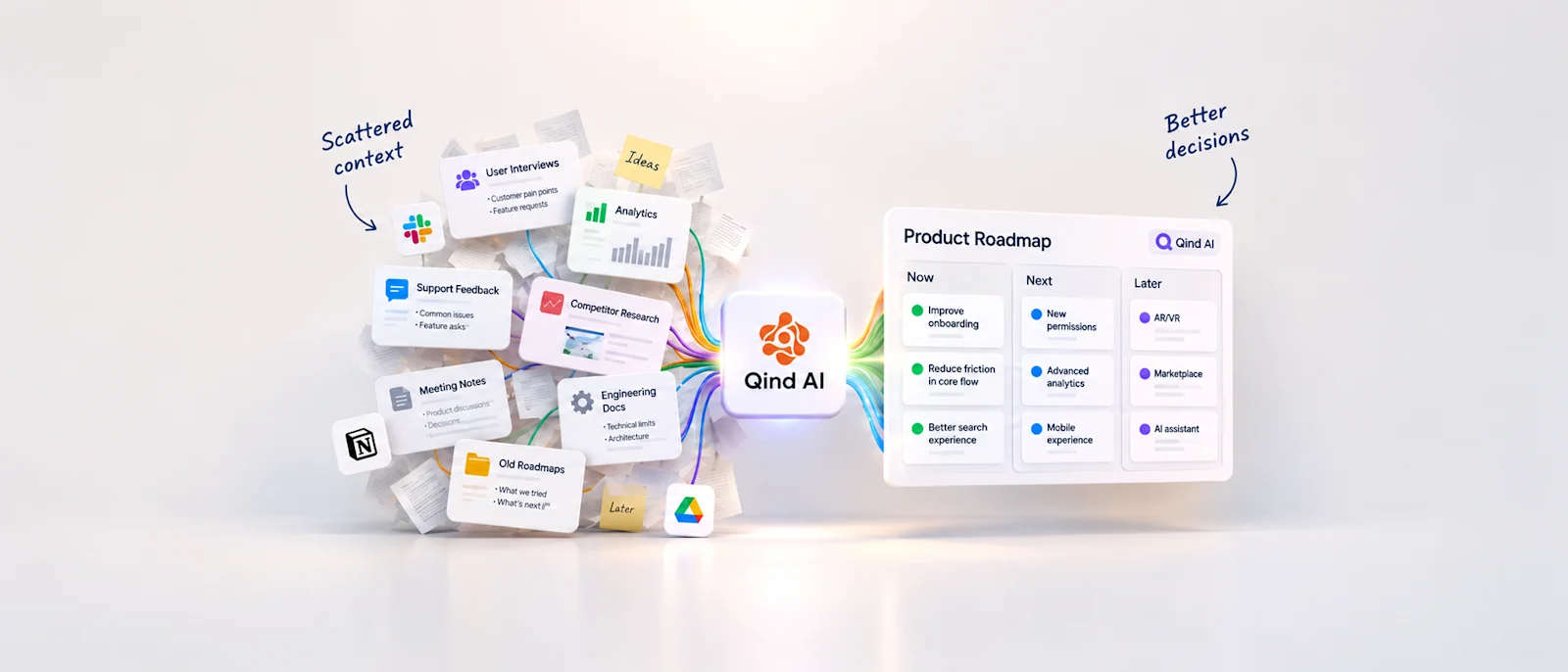

Product teams have become very good at collecting feedback. Customer Success records requests, Sales forwards prospect objections, support teams receive complaints, product managers run interviews, review platforms contain public criticism, and users send comments through forms, emails, calls, and chat.
The result is often thousands of individual pieces of customer information spread across multiple systems. On paper, this looks valuable. More customer feedback should mean a better understanding of the market and better product decisions.
In practice, that is not always what happens.
Teams often collect far more feedback than they can meaningfully interpret. They build large repositories of comments, requests, screenshots, interview notes, tickets, and feature ideas, yet still struggle to answer basic questions such as: What are users actually struggling with? Is this problem widespread? Which type of customer experiences it most often? Is this a recurring pattern or just one loud request?
The problem is not a lack of feedback.
The problem is that feedback and evidence are not the same thing.
A Customer Comment Is a Signal, Not a Conclusion
Imagine that one customer says, “Export is confusing.”
That statement matters, but on its own it does not tell you very much. It does not tell you how many people experience the problem, whether the issue affects important customers, whether users fail to complete the task, or whether the real problem is export functionality at all.
Another user might say, “It took me five minutes to find CSV download.” A third user might ask Support, “Where is the download button?” Someone else may abandon the export flow entirely without ever sending feedback.
These look like separate comments, but they may represent the same underlying product problem.
This is where product evidence begins. Evidence emerges when individual signals can be connected, compared, and interpreted as part of a larger pattern.
A single request may be interesting. Ten related signals from the same customer segment may be strategically important.
The difference is not the number of comments alone. It is the context around them.
More Feedback Can Actually Create More Noise
Product teams often treat feedback collection as an unquestioned good. Add another feedback form. Connect another survey tool. Record more interviews. Import more support tickets. Save more customer quotes.
Eventually, the team has an impressive amount of data but a weak understanding of what it means.
This creates a strange situation: the organization becomes richer in information while remaining poor in insight.
The more sources a team adds, the harder it becomes to see relationships between them. The same issue may appear as a support complaint, a sales objection, a research observation, and a feature request. If each item remains isolated inside its original tool, the organization may treat them as four unrelated events.
That fragmentation is dangerous because product decisions are rarely driven by one perfectly written piece of feedback. They emerge from patterns.
When those patterns remain invisible, teams can overreact to isolated comments and underreact to real systemic problems.
The Loudest Customer Is Not Always the Strongest Evidence
One of the biggest risks in feedback-driven product development is confusing intensity with importance.
A customer who sends five emails about a feature may appear more important than twenty customers who quietly struggle with the same workflow. An enterprise account may push strongly for a highly specific request, while hundreds of smaller users face a more fundamental usability issue without ever reporting it.
Feedback volume and feedback importance are not automatically the same.
Good product evidence requires more context. Which segment does the feedback come from? How frequently does the issue occur? What business impact does it create? Does behavioral data support the complaint? Have other customers described the same underlying problem using different language?
Without this context, prioritization can become a contest between whoever speaks the loudest.
That is not customer centricity.
It is signal distortion.
Feature Requests Are Particularly Dangerous
Feature requests look concrete, which makes them easy to collect and easy to count. A customer says, “We need dark mode,” “We need an API,” or “We need a dashboard export,” and the request enters a backlog.
The problem is that customers usually describe solutions, not necessarily the underlying problem.
A request for a dashboard export may actually mean, “I need to share this information with my manager.” A request for an API may mean, “I have to repeat this process manually every day.” A request for a new report may mean, “I cannot answer an important business question using the current product.”
If teams treat the requested feature as the requirement, they may build exactly what was asked for while missing what the customer actually needed.
Strong evidence asks a deeper question: what problem is producing this request?
That changes how product teams interpret feedback. The goal is no longer to count how many people requested Feature X. The goal is to understand the needs, behaviors, constraints, and outcomes behind those requests.
Product Evidence Needs Multiple Sources
The strongest product conclusions rarely come from one channel.
Suppose several users complain that onboarding is confusing. That is useful qualitative feedback. If analytics also show a significant drop-off at the same step, the evidence becomes stronger.
If recorded sessions show users repeatedly hesitating around the same interface, the picture becomes clearer. If support tickets contain similar questions and customer interviews reveal the same frustration, the team is no longer looking at a few isolated complaints.
It is looking at converging evidence.
This is one of the most important differences between feedback collection and evidence building.
Feedback tells you what someone said.
Evidence helps you understand what is likely happening.
The best product teams combine different types of signals rather than treating each source as an independent truth.
Customer comments, behavioral data, usability research, support patterns, commercial impact, and technical context can all contribute to the same product conclusion.
Patterns Matter More Than Individual Quotes
Customer quotes are powerful. They make problems feel real and help teams connect with users. But memorable quotes can also create bias.
A dramatic comment from one frustrated customer may dominate a product discussion simply because people remember it.
Patterns are more reliable.
If twenty customers use different words to describe the same obstacle, that pattern matters more than whether any one quote sounds impressive.
This is why product teams need to move from storing feedback toward grouping and connecting related signals.
“Export is confusing,” “Where is CSV?”, “I cannot find download,” and repeated abandonment of the export workflow may all point toward one problem cluster.
Once that relationship becomes visible, prioritization becomes much easier.
The team is no longer debating individual comments. It is evaluating evidence around a product problem.
Evidence Also Needs Time
Customer feedback does not exist outside of time.
A problem that mattered twelve months ago may have already been fixed. A request collected before a major redesign may no longer describe the current product. A competitor reference from two years ago may no longer be relevant.
Without time context, old feedback can quietly influence new decisions long after it has lost its validity.
This is another reason large feedback repositories become dangerous. They often preserve information without preserving its relevance.
A useful evidence system should make it possible to understand when a signal was captured, what version of the product it referred to, what customer context surrounded it, and whether later work changed the situation.
Otherwise, old evidence can become indistinguishable from current evidence.
That leads to poor prioritization because teams may solve problems that no longer exist while overlooking newer patterns.
Evidence Should Make Disagreement Easier
One underrated benefit of strong product evidence is that it improves disagreement.
Product teams should disagree. Product managers, engineers, designers, Sales, Customer Success, and leadership often see the same problem from different perspectives.
The problem begins when disagreement relies entirely on opinions.
Sales says customers need a feature. Product says it is not a priority. Engineering says the effort is too large. Leadership believes the opportunity is strategic.
Without shared evidence, the discussion quickly becomes political.
With stronger product evidence, the conversation changes. The team can examine how many customers raised the issue, which segments they belong to, how usage data behaves, what research shows, what revenue is affected, and what technical tradeoffs exist.
Evidence does not automatically produce agreement.
It produces a better disagreement.
That is far more valuable.
The Goal Is Not to Create a Bigger Feedback Database
A common mistake is to respond to feedback fragmentation by building one enormous repository.
Move every ticket, quote, interview, survey, review, and note into one database.
That may improve access, but centralization alone does not create understanding.
A giant database of disconnected information is still a giant database of disconnected information.
The important question is whether related evidence can be found and understood together.
Can a PM looking at a pricing problem see relevant customer interviews, Sales objections, support tickets, previous experiments, analytics, and competitor research without manually recreating the relationship every time?
That is the real challenge.
Product knowledge becomes useful when connections survive.
AI Can Help Teams Move From Collection to Interpretation
This is one area where AI can fundamentally change product research workflows.
Traditional feedback systems depend heavily on tagging, folders, manual categorization, and people remembering where things were stored. As the amount of information grows, maintaining those systems becomes increasingly difficult.
AI can help teams identify connections that are difficult to see manually.
Instead of searching for one exact phrase, a PM can ask broader questions such as: “What complaints do we have about onboarding?”, “Which customer requests relate to data export?”, “What recurring problems appear across enterprise interviews?”, or “What evidence suggests that users struggle with collaboration?”
This changes the role of a feedback repository.
It stops being a place where customer comments go after they are collected and starts becoming a source that can actively support product reasoning.
However, AI does not remove the need for judgment. A repeated pattern is not automatically a priority, and a generated summary is not automatically evidence. Teams still need to evaluate customer importance, business impact, product strategy, data quality, and technical constraints.
AI can reduce the work required to surface patterns.
Product teams still have to decide what those patterns mean.
From Feedback Repository to Product Evidence System
A mature feedback system should do more than store customer comments.
It should help answer product questions.
What problems occur repeatedly?
Which customer segments experience them?
How has the issue changed over time?
What behavioral data supports the feedback?
What previous decisions are related to the problem?
What research already exists?
What assumptions are still unproven?
That requires a shift in mindset.
The goal is not “collect everything.”
The goal is “preserve enough context to make the information useful later.”
This is what turns scattered customer signals into product evidence.
Where Qind Fits
This is one of the problems Qind is designed to address.
Product teams collect relevant information from many different places: customer conversations, research, web pages, competitor material, internal notes, support observations, product documents, screenshots, and other sources.
The difficulty begins when the team needs to connect those fragments later.
Qind helps people capture and organize useful context so related information can be retrieved and questioned together rather than remaining trapped in separate tools or forgotten files.
For a product manager, the important shift is from asking, “Where did we save that feedback?” to asking a more useful question such as, “What evidence do we have that this is a real product problem?”
That is the difference between storing feedback and building product knowledge.
Better Products Do Not Come From More Feedback
Product teams should absolutely listen to customers.
But listening is not the same as collecting.
A company can have thousands of feedback items and still misunderstand its users.
The teams that make better decisions are not necessarily the teams with the biggest feedback databases. They are the teams that can turn individual signals into patterns, preserve the context around those patterns, and connect customer evidence to product decisions.
The next time someone says, “Customers are asking for this,” the most useful response may not be, “How many?”
It may be:
“What evidence do we actually have?”
That question is where better product decisions begin.