
Tabii. Aşağıda sadece body’yi, temiz ve Contentful’a direkt yapıştırabileceğin formatta veriyorum. Kısa tek satırlı paragraf yok.
Your Roadmap Is Not the Problem. Your Context Is.
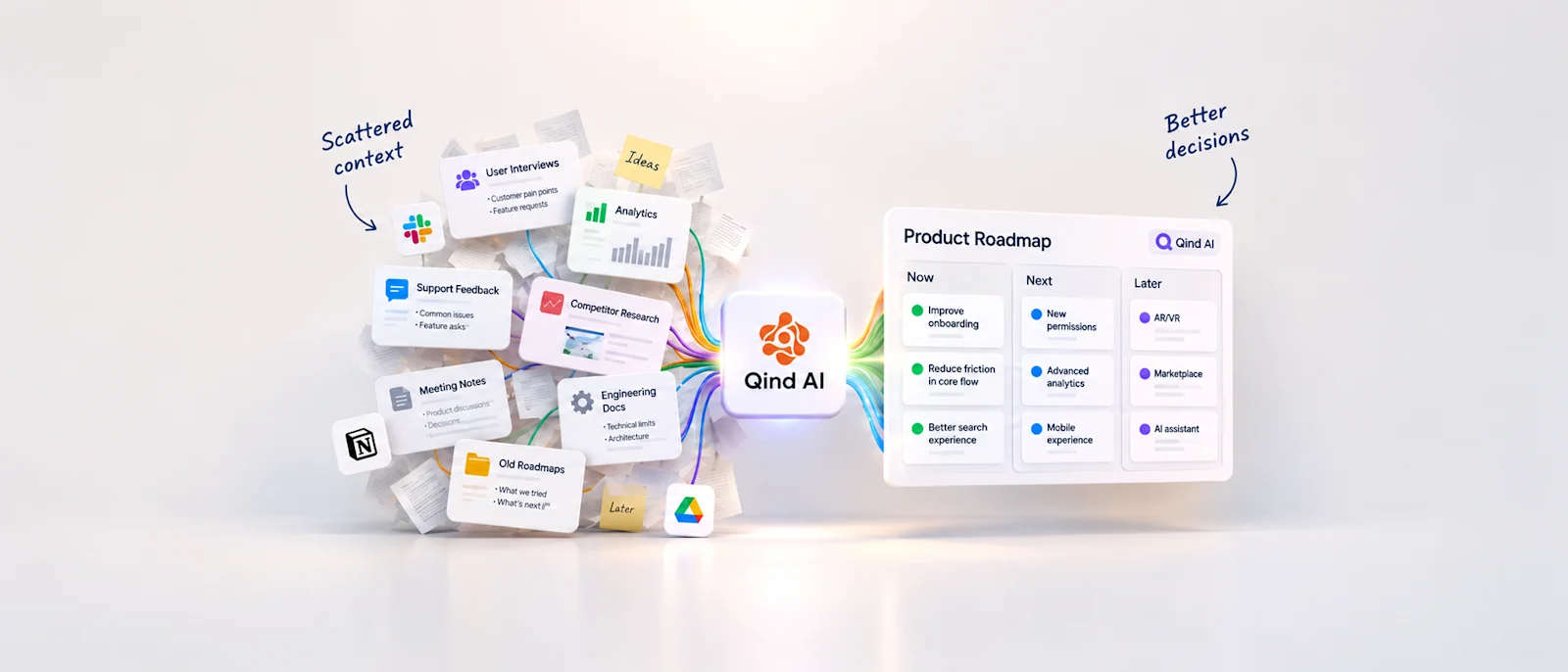
Product teams spend an enormous amount of time trying to make better decisions. They run user interviews, analyze product data, review support tickets, watch competitors, debate priorities, write requirements, hold planning meetings, and maintain roadmaps that are supposed to turn all of that information into direction. From the outside, this looks like a structured decision-making process. Inside the team, however, the reality is often much messier.The customer interview that changed everyone's thinking happened three months ago and lives in a transcript nobody has opened since. The analytics screenshot is buried in Slack. A competitor observation is sitting in someone's notes. The reasoning behind an old roadmap decision was discussed in a meeting but never captured properly. Support has been hearing the same complaint for weeks, while the product team is debating the same feature as if the conversation were starting from zero.Then someone asks the question every product team eventually hears: “Why did we decide this?” The uncomfortable answer is often not that nobody thought about it. The answer is that the context is scattered. Bad product decisions are not always the result of bad thinking. Very often, they are decisions made with an incomplete picture.
Product Teams Rarely Have an Information Problem
Most modern product teams are not short on information. If anything, they have too much of it. Every customer conversation creates new insight. Every analytics tool produces another set of signals. Sales brings objections from prospects, support brings recurring complaints, engineering brings technical constraints, design brings usability findings, and leadership brings commercial priorities. Competitor research adds another layer, while previous experiments, roadmap discussions, and product documentation continue accumulating in the background.The problem is that these signals rarely arrive in the same place or at the same time. One piece of context is in a meeting transcript, another is in Jira, another is buried in a dashboard, and something important may exist only in the memory of the person who happened to be in the room when a decision was made. This creates a strange situation. A team can possess almost everything it needs to make a strong decision and still make a weak one because the relevant pieces were never visible together. The information existed. The context did not.
Every Product Decision Is Really a Context Assembly Problem
Consider what happens when a product manager evaluates a feature request. The request itself might look simple: “Customers want bulk editing.” If the decision is based only on that sentence, the feature may appear obvious. Several customers have mentioned it, competitors offer it, and sales says it would help close deals. Put those signals together and prioritizing the feature seems reasonable.But now add the missing context. Perhaps previous user research showed that most customers asking for bulk editing are trying to compensate for a confusing workflow somewhere else. Maybe analytics shows that only a very small percentage of active users ever reach the part of the product where bulk editing would exist. Engineering may have already identified a technical limitation that makes the implementation significantly more expensive than it appears. There may even have been an experiment six months ago showing that simplifying the original workflow reduced the need for bulk actions altogether.The feature request did not change. The context around it did. This is why good product management is rarely about reacting to the loudest signal. It is about assembling enough relevant context to understand what that signal actually means.
The Same Conversation Keeps Happening Because the Previous One Disappeared
One of the clearest symptoms of fragmented context is repetition. Teams find themselves discussing questions they are certain they have already discussed before. Someone remembers that a decision was made, another person remembers disagreeing with it, and a third person vaguely remembers some customer research that influenced the outcome. What nobody can easily reconstruct is the full reasoning.The meeting may still exist on the calendar. There may be notes somewhere. A Slack thread probably contains part of the conversation. The final decision might even appear in a roadmap ticket. Yet the connection between the evidence, the discussion, and the decision has disappeared. When this happens repeatedly, teams start paying a hidden productivity tax. Time that should be spent evaluating new information gets spent rebuilding old context.People search through messages, ask colleagues what happened, reopen old tickets, and reconstruct decisions from fragments. Sometimes the reconstruction works. Sometimes the team simply has the same debate again. The cost is not only wasted meeting time. Repeated discussions also make decision-making feel less trustworthy because nobody is completely sure whether the team is learning or merely restarting.
A Roadmap Shows the Decision, Not Necessarily the Reason
Roadmaps are useful because they create a visible representation of direction. They tell the organization what the team plans to work on, what comes later, and what may not happen at all. But a roadmap is usually much better at recording the result of a decision than preserving the context that produced it.A roadmap item might say “Improve onboarding” or “Build team permissions.” That tells you what the team intends to do. It does not automatically tell you which customer interviews influenced the decision, which behavioral data supported it, what alternatives were rejected, which assumptions remain unproven, or why the team decided this work mattered more than another opportunity.At the time the roadmap is created, this may not feel like a problem because everyone involved still remembers the discussion. Three months later, some of those people may be working on different projects, priorities may have changed, and new team members may have joined. What once felt obvious now looks like a decision without a history. The roadmap is still there. The reasoning is not.
More Documentation Does Not Automatically Solve This
The obvious response to fragmented context is usually more documentation. Write better meeting notes. Add more details to Jira. Create a decision log. Document user research carefully. Keep competitor findings in a shared workspace. Make sure every roadmap item has enough explanation.All of those practices can help, but there is a limit to how far documentation alone can take a team. The problem is not simply that information was never written down. Often, the information has been documented perfectly well. It is just distributed across too many systems and organized according to the structure of those systems rather than the questions people will eventually ask.A user interview may be filed under the customer's name. A competitor finding may be stored in a research document. A product decision may exist inside a roadmap item. An engineering limitation may be explained in Jira. A useful Slack conversation may never leave Slack at all. Each piece is correctly stored from the perspective of the tool that contains it. The product decision, however, does not care which tool owns the information. It needs all of the relevant context at once.
Search Is Useful, but Product Teams Often Do Not Know What to Search For
Traditional search works best when you already know what you are looking for. If you remember the name of a project, customer, feature, or document, finding it is relatively straightforward. Product decisions are harder because the question often begins with an idea rather than a filename.A PM may remember that someone raised a concern about enterprise permissions months ago without remembering whether it came from an interview, a support conversation, a sales call, or an internal discussion. They may remember that the team once rejected a similar feature but not remember the terminology used at the time. They may want to understand everything the company has learned about a particular user problem even though those insights were collected under different projects and different names.This is where the difference between storing information and working with context becomes important. Product teams do not always need another folder. They need ways to bring related knowledge together even when they cannot remember exactly where it came from.
Recency Can Quietly Become More Powerful Than Evidence
When context is fragmented, another problem appears: the newest information often becomes disproportionately influential. The customer complaint mentioned this morning is easy to remember. The competitor launch everyone saw yesterday feels urgent. The sales request raised in the latest meeting is fresh in everyone's mind.Meanwhile, research completed six months ago may have involved twenty customer conversations and much stronger evidence, but if nobody remembers where it is, it has very little influence on today's decision. This creates a recency bias built directly into the team's information environment. The easiest context to access becomes the context most likely to influence the roadmap.Strong evidence can lose to fresh evidence simply because fresh evidence is visible. Good product decisions require the opposite. Information should matter because of its relevance and quality, not because someone happened to mention it recently.
The Loudest Customer Is Not the Entire Market
Fragmented context can also distort how teams interpret customer feedback. A single customer may present an urgent and convincing request. Sales may strongly support it because the account is strategically important. Support may have heard something similar from a few other customers. Suddenly the request begins to feel like a pattern.It might be a pattern, but the team needs context to know. How many customers have actually raised this problem? Which customer segments are affected? What were those users trying to accomplish? Have similar requests appeared under different wording? Does product usage support the same conclusion? Has the team investigated the underlying problem before?Without that broader picture, product prioritization can become a competition between whichever signals happen to be visible at the moment. Context transforms isolated anecdotes into something that can actually support a decision.
AI Does Not Fix Bad Context Automatically
AI is making it dramatically easier to analyze product information. Teams can summarize interviews, classify feedback, generate themes, query documents, review support conversations, and extract insights much faster than before. This is a real improvement, especially for teams that once spent hours manually reviewing large amounts of qualitative information.But AI has the same fundamental constraint as every other decision-making system: it can only reason over the context it has access to. If one important customer interview is in one system, the analytics interpretation is in another, competitor research is stored somewhere else, and the rationale behind the previous decision was never connected to any of them, an AI assistant may produce an excellent answer from an incomplete picture.That makes context quality even more important in the AI era, not less. As reasoning becomes cheaper and faster, the quality of the information being reasoned over becomes a bigger differentiator. A powerful AI with fragmented context can simply help a team reach an incomplete conclusion faster.
The Best Product Teams Build Decision Memory
There is a useful distinction between documentation and decision memory. Documentation records what happened. Decision memory helps a team reconstruct why it happened.A strong decision memory makes it possible to look at a product question and recover the evidence around it. What did customers say? What did the data suggest? Which assumptions were being made? What alternatives were considered? What did competitors do? Which constraints mattered? What decision followed, and what changed afterward?This does not require turning every product manager into an archivist. In fact, if maintaining decision memory requires constant manual organization, people eventually stop doing it. The more practical goal is to make useful context easier to preserve as part of the work teams already do. Over time, this creates something far more valuable than a collection of documents. It creates organizational memory.
This Is Where Qind Fits
For product teams, the value of Qind is not simply having another place to save information. The more interesting opportunity is creating a layer where useful product context from different sources can remain accessible beyond the moment when it was created.A user research insight can matter again when the same problem appears in a future roadmap discussion. A competitor observation collected today may become relevant during positioning work months later. Notes from one project can unexpectedly inform another. An old product decision can become easier to understand when the evidence surrounding it is still available rather than scattered across disconnected locations.That is especially important because product work rarely follows neat organizational boundaries. The context behind one decision can include research, notes, webpages, documents, screenshots, ideas, technical information, and conversations created at completely different moments. The goal is not to force everything into one giant folder. The goal is to make the useful relationships between those pieces easier to recover.
A Product Team Should Be Able to Ask Better Questions
Imagine preparing for a roadmap discussion and being able to begin with questions instead of searches. What have customers told us about this problem? What evidence contradicts the current direction? Have we investigated something similar before? Which competitor findings are relevant? What assumptions supported the previous decision? What have we learned since then that should cause us to reconsider it?Those questions represent a much more mature product workflow than simply opening the roadmap and debating whatever is currently visible. The quality of a decision often depends on the quality of the context available at the moment the decision is made.Better access to context does not guarantee that a team will always choose correctly. Product development is full of uncertainty, and even excellent evidence can lead to a decision that later proves wrong. But there is an important difference between making a decision that turns out to be wrong and making a decision without looking at what the organization already knew.
Changing Your Mind Should Be a Feature of the System
Good product teams change their minds. New evidence appears, customer behavior changes, markets move, technical constraints disappear, and assumptions turn out to be wrong. A roadmap should evolve when reality changes.The problem begins when teams cannot distinguish between a genuinely new insight and something they already learned but forgot. If an old decision was based on evidence that is no longer valid, changing direction is rational. If the team reverses a decision simply because nobody can recover the original reasoning, that is something else entirely.A strong context system should make both situations visible. It should help the team understand what it believed before, why it believed it, and what new evidence now justifies a different direction. That is how product decisions become cumulative rather than repetitive.
Your Roadmap Is Not the Problem
When roadmap discussions become difficult, it is tempting to blame the roadmap. Maybe the prioritization framework is wrong. Maybe the planning process needs to change. Maybe the team needs another scoring system, another template, or another workshop.Sometimes those things genuinely need improvement. But sometimes the roadmap is simply revealing a deeper problem. The team is trying to make decisions without being able to see enough of what it already knows.User research exists. Customer feedback exists. Product data exists. Competitive intelligence exists. Technical knowledge exists. Previous decisions exist. The problem is that all of those things are scattered across different tools, documents, conversations, and people's memories. A better roadmap cannot compensate for missing context. Better context, however, can completely change what belongs on the roadmap.
The Future of Product Work Is Not More Information
Product teams are going to have access to more information than ever before. AI will make research faster, analysis cheaper, transcription automatic, and large collections of feedback much easier to process. Producing information will not be the difficult part.Knowing which information matters together will be.The teams that make better decisions will not necessarily be the teams with the most dashboards, the most documentation, or the largest collection of AI tools. They will be the teams that can bring the right context into the room when a decision needs to be made.Because product decisions do not happen inside roadmaps. They happen inside context. And when that context is scattered, even very smart teams can make surprisingly poor decisions.