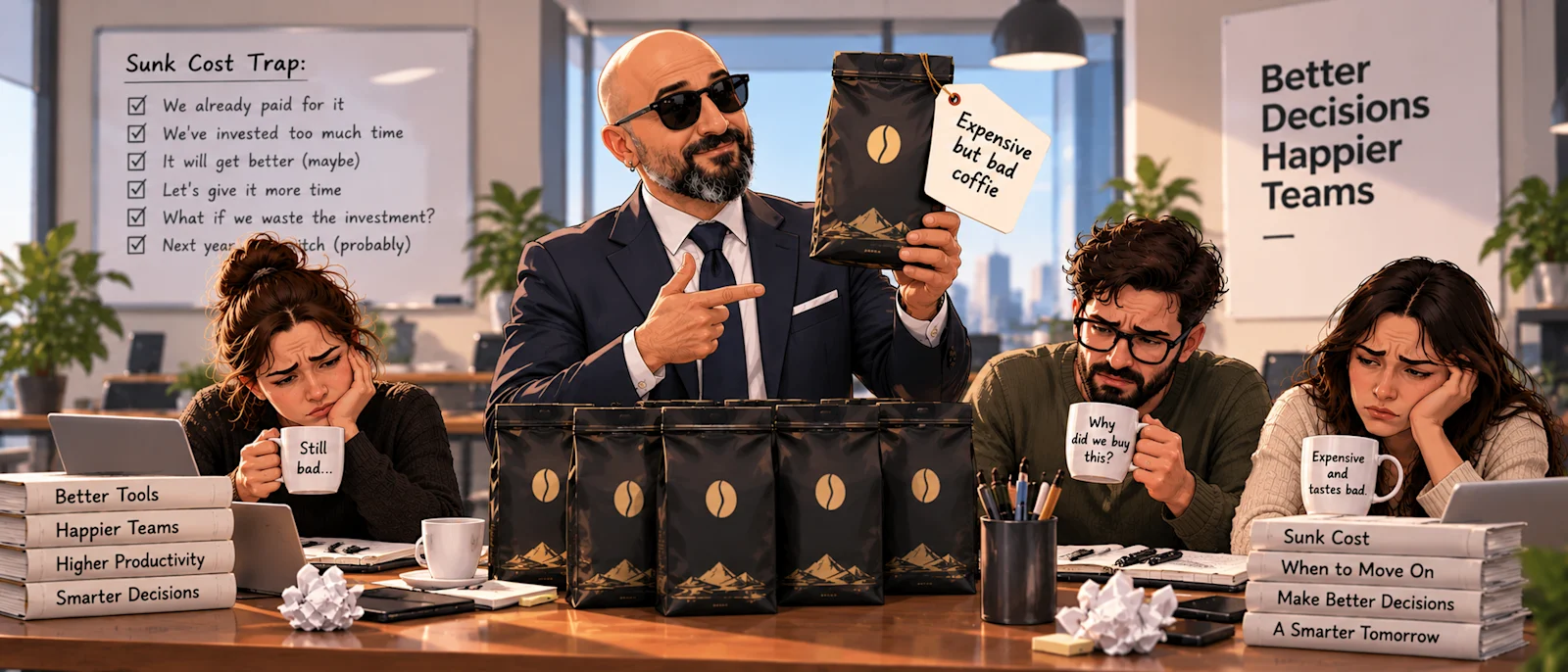
A few days ago, I went to the supermarket to buy coffee. They had a new Lavazza. €9.50. Most coffee there costs around €4.50–€5, so this one was almost twice the price.
I didn't research it. I didn't check reviews. I didn't compare it with anything. I didn't even stop to ask myself why it was so expensive. My brain did something much faster:
Expensive = probably good.
So I bought it. That could have been the end of the story. Unfortunately, I went to another supermarket.
Then I Found the Same Coffee for €4.50
I needed a few other things that I normally buy from another supermarket. And there it was. The exact same coffee. €4.50. Less than half the price I'd just paid.
At this point, a reasonable person might have thought:
"Maybe I just massively overpaid for an ordinary bag of coffee."
My brain found a much more satisfying explanation.
"Wow. They sell the good coffee cheap here."
So naturally... I bought three more bags. Yes. Three. I had somehow taken evidence that my original assumption might have been wrong and used it as evidence that my original assumption was even more right.
I went home feeling like I'd found a bargain. Then I made a cup. It was terrible. Not "maybe I need to adjust the amount of coffee" terrible. Not "interesting flavor profile" terrible. Just terrible.
And now I own four bags of it.
The Worst Part Isn't That I Was Wrong
Buying bad coffee isn't particularly interesting. People buy things they don't like all the time. The interesting part is what happened after new information appeared.
My original decision was based on a very simple assumption:
Higher price → higher quality.
Then I encountered evidence that should have made me question that assumption. The exact same product was selling for less than half the price somewhere else.
But instead of reconsidering my original conclusion, I created a new explanation that allowed me to keep it. The coffee wasn't overpriced at the first supermarket. No. Obviously, the second supermarket had somehow discovered the secret of selling premium coffee for €4.50. Perfect. Three more, please.
This is funny when we're talking about coffee. It becomes considerably less funny when we realize how often we do the same thing with decisions that actually matter.
We Don't Like Discovering That Past-Us Was Wrong
We like to imagine that when new evidence appears, we update our beliefs. Sometimes we do. But sometimes we do something much more creative.
We update the story instead.
We've already invested in the decision. We've defended it. We've spent time on it. Maybe we've spent money on it. Maybe other people know we supported it.
Changing direction now doesn't feel like simply making a new decision. It feels like admitting the previous one was wrong. So we start negotiating with the evidence.
Maybe we just need to give it more time. Maybe the team isn't using it correctly. Maybe we haven't configured it properly. Maybe the market will change. Maybe the next release will fix it. Maybe the coffee tastes better if I change the brewing method.
Sometimes those things are true. And sometimes we're just standing in the kitchen with four bags of bad coffee.
Companies Have Coffee Bags Too
The same behavior appears everywhere at work.
A company chooses a tool. The migration takes three months. Six months later, everyone knows the tool doesn't really fit the workflow. But replacing it would mean acknowledging that the migration was a mistake. So the company keeps it.
We've already invested too much in this.
A team creates a process. It made sense two years ago. Today it adds meetings, approvals, and unnecessary work. Everyone complains about it. But:
This is how we've always done it.
A product team spends months building a feature. Research later suggests customers don't really want it. But abandoning it feels impossible.
We've already built 80%.
A developer spends hours pursuing one technical solution. New evidence suggests the architecture itself might be wrong. But another hour feels easier than abandoning the previous six.
So: One more workaround. One more patch. One more configuration change.
One more bag of coffee.
The Money Is Gone. The Question Is What Happens Next.
There's a useful idea in economics and decision theory called a sunk cost.
A sunk cost is something you've already spent and cannot recover. Money. Time. Effort. Resources.
The important part is that the cost already happened. It shouldn't determine whether continuing is the best decision from this point forward.
That's easy to understand intellectually. It's much harder emotionally.
Let's go back to my coffee. I've already paid for four bags. That money is gone.
Now imagine I genuinely dislike drinking it. I have two options.
I can throw it away, give it to someone who likes it, or simply stop drinking it. Or I can spend the next few weeks drinking coffee I dislike because:
"I paid for it."
But drinking it doesn't recover the money. The money is gone either way. All I've done is add another cost:
weeks of bad coffee.
That's the strange thing about sunk costs. Sometimes we try so hard to justify yesterday's cost that we create tomorrow's cost too.
Yesterday's Mistake Becomes Tomorrow's Obligation
That's the part of this story that stayed with me. Making the wrong decision isn't necessarily the biggest problem.
We're going to make bad decisions. We'll buy the wrong thing. Choose the wrong tool. Believe the wrong assumption. Start the wrong project. Save the wrong information. Follow the wrong strategy.
Being wrong is unavoidable. The dangerous part is when we turn being wrong into a commitment.
I chose it, therefore I must continue.
Suddenly a decision made by a version of you with less information becomes a rule that the current version of you has to obey. That's backwards.
Past-you had less evidence. Current-you knows more. Why should the less-informed version get the final vote?
Good Research Should Occasionally Make You Uncomfortable
There's another version of this problem that happens with information.
We often say we're researching something. But sometimes what we're actually doing is collecting evidence for something we've already decided.
We search. We save articles. We bookmark reports. We ask AI questions. We collect statistics.
But notice what happens when we encounter something that contradicts our position. There's a temptation to treat supporting evidence and contradicting evidence differently.
One gets saved. The other gets explained away.
That's not really research. That's building a case for ourselves.
Real research has to contain the possibility of this sentence:
"I was wrong."
Otherwise, what's the point?
If no amount of new information could change your conclusion, you're not investigating a question. You're defending an answer.
A Knowledge Base Shouldn't Just Remember What You Know
This is where I think knowledge management becomes much more interesting than simply saving information.
Most personal knowledge systems are built around a basic idea:
Store things I might need later.
Articles. PDFs. Notes. Research. Screenshots. Ideas.
That's useful. But a genuinely valuable knowledge system should do something else too.
It should help you encounter information that challenges what you currently believe.
Because knowledge isn't valuable only when it confirms your decisions. Sometimes its greatest value is showing you that a decision no longer makes sense.
Imagine researching a product direction and saving everything you find. Three months later, you ask:
"What evidence have I collected that supports this decision?"
Useful. But there's a better question:
"What evidence have I collected that contradicts this decision?"
Now we're getting somewhere.
AI Shouldn't Just Agree With Us Faster
This matters even more as AI becomes part of everyday knowledge work.
AI makes it incredibly easy to produce convincing arguments. Give it a position and ask it to defend it. It probably can. Give it the opposite position. It can probably defend that too.
That means the quality of our questions becomes extremely important.
If we only use AI to strengthen what we already believe, we can become wrong much more efficiently.
The interesting use isn't:
"Prove that my idea is good."
It's:
"What am I missing?"
"What evidence contradicts my assumption?"
"What would have to be true for this decision to be wrong?"
"Have I previously saved something that challenges this conclusion?"
That's a very different relationship with AI. AI becomes less of an agreement machine and more of a thinking partner.
This Is Where Qind Can Become More Than Storage
One reason I care about keeping research, articles, notes, PDFs, images, and other material accessible isn't simply because I want to remember more.
I want previous knowledge to remain available when I'm making new decisions.
That's where something like Qind becomes useful.
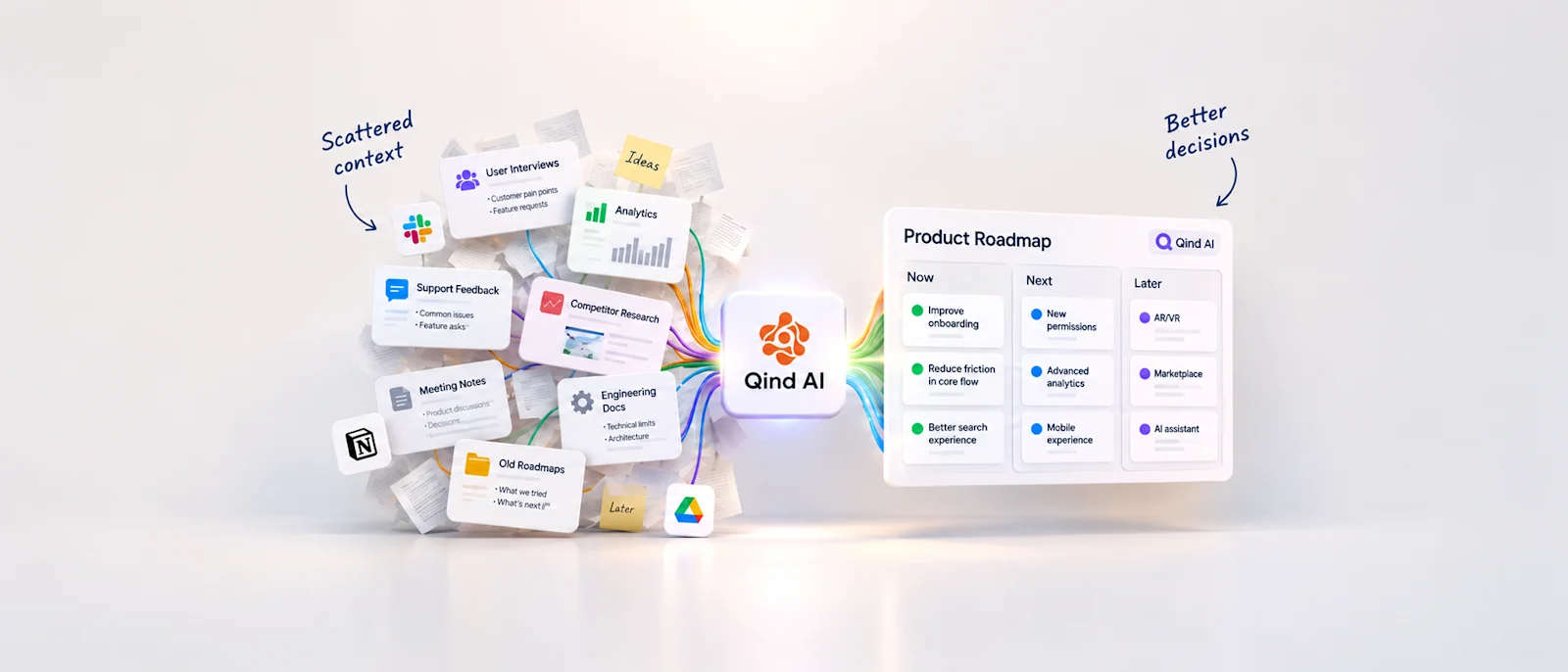
You can capture information while you're researching and make it searchable later by meaning rather than relying entirely on filenames or folders. You can return to material you've collected and ask questions across it.
But there's an important distinction:
The goal shouldn't always be:
"Find evidence for what I think."
Sometimes it should be:
"Show me what I've collected that might prove me wrong."
That's a much more interesting use of a personal knowledge system.
Because a good knowledge base shouldn't just preserve your thinking.
It should give your thinking a chance to evolve.
Changing Your Mind Is Not Losing
There's a cultural problem underneath all of this too.
We often treat consistency as a virtue. If someone changes their opinion, we sometimes interpret it as weakness.
"But you said something different six months ago."
Of course I did. Six months ago I had six months less information.
The question shouldn't be:
"Did you remain consistent?"
The better question is:
"Did you update when the evidence changed?"
There is nothing intelligent about remaining perfectly consistent with an outdated version of yourself.
Consistency is useful when the underlying facts remain the same. When the facts change, refusing to change with them isn't consistency.
It's stubbornness.
Maybe We Should Track Changed Minds
Imagine if we treated changed decisions differently.
Instead of hiding them, we recorded them.
Original assumption: This tool will reduce manual work.
New evidence: Adoption remained low and manual work increased.
Decision: Replace it.
That's not a failure log. That's organizational intelligence.
Because six months later, someone can understand not only what was decided, but why the decision changed.
That context is incredibly valuable.
A knowledge system shouldn't only preserve conclusions. It should preserve the journey between conclusions.
What did we believe? What evidence did we have? What changed? What did we learn?
That's how mistakes become knowledge instead of recurring expenses.
Four Bags of Coffee
There are currently four bags of coffee in my kitchen. I don't like the coffee. I know I don't like the coffee.
And there's still a part of my brain saying:
"Well... you bought it. You should finish it."
Which is ridiculous.
Drinking the coffee won't bring the money back. It will only make the mistake last longer.
And maybe that's the simplest way I can explain sunk costs now:
A sunk cost is when yesterday's mistake starts trying to become tomorrow's obligation.
We're all going to make wrong decisions. The goal isn't to eliminate them. The goal is to make sure new information is allowed to change what happens next.
That's true for coffee. It's true for products. It's true for technology. It's true for research. And it's true for the things we believe.
Good knowledge doesn't prevent us from being wrong.
It helps us notice when it's time to stop being wrong.