
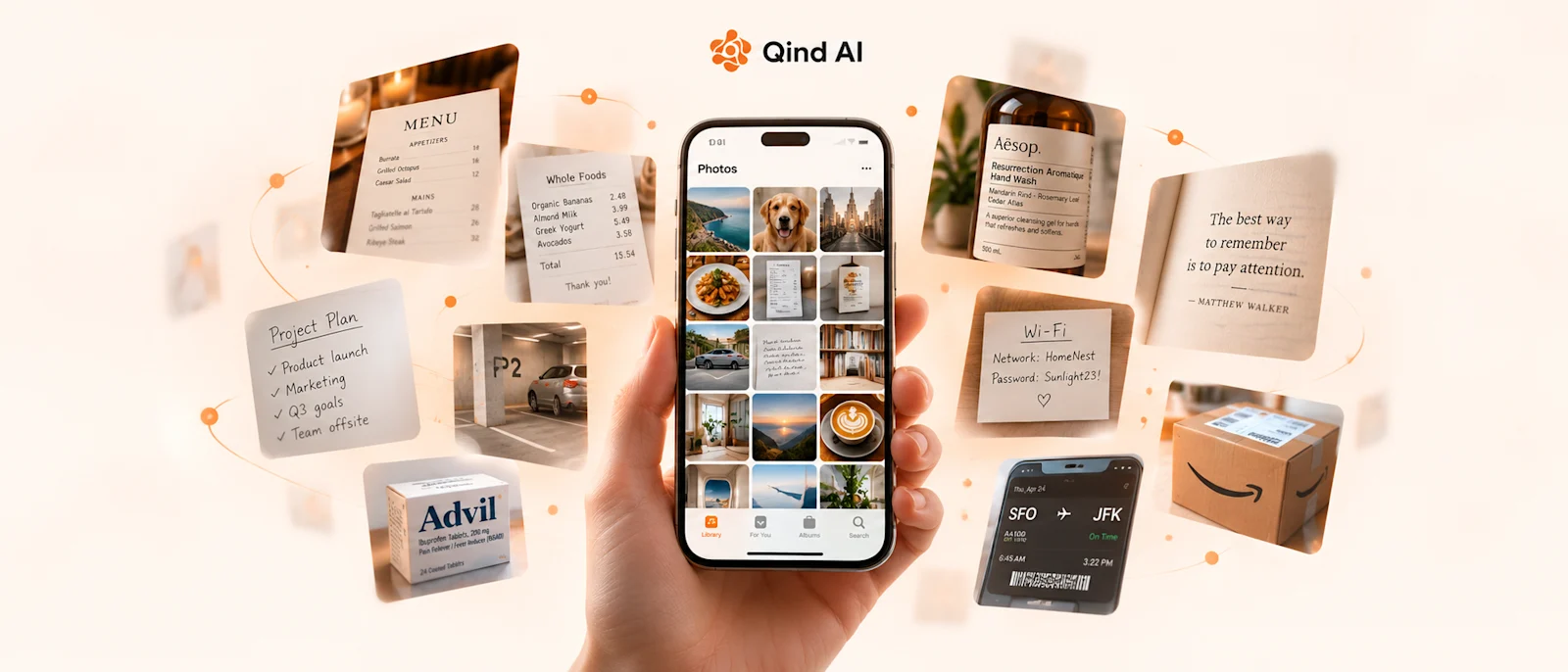
There was a time when most photos were taken because something felt worth remembering: a trip, a birthday, a person, a view, a moment. Now open your camera roll and look again. Between the holidays and family photos, there is probably a picture of a parking spot, a restaurant menu, a product label, a book page, a whiteboard, a receipt, a medicine box, a Wi-Fi password, a pair of shoes you thought you might buy later, or maybe a photo of another screen because taking the photo felt faster than opening a notes app. None of those photos were really about photography. You took them because you did not want to forget.
Your Camera Roll Is Becoming an External Memory
For many of us, the camera has quietly become one of the fastest capture tools we own. We see something useful, point the phone at it, and move on. There is almost no friction because we do not need to type a note, create a folder, choose a title, or decide where the information belongs. The photo becomes a promise to our future self: “I don't need to deal with this now. I'll remember why I took it later.” At the moment, that feels completely reasonable. The problem appears a few weeks later.
Future You Has No Idea What Past You Was Thinking
Imagine scrolling through your gallery and finding a photo of a restaurant menu from three months ago. Why did you take it? Was there a dish you wanted to try? Were the prices interesting? Did someone recommend the place? Were you comparing it with another restaurant, or did the menu contain something completely unrelated to food that caught your attention? The image survived, but the intention did not.
The same happens with photos of books, presentations, products, documents, signs, receipts, packaging, or handwritten notes. You may still be able to see exactly what was in front of you, but the reason it mattered is often gone. That is the strange weakness of photographic memory systems: they preserve the object very well, but they often lose the context around it.
We Are Not Taking Too Many Photos. We Are Saving Too Many Unfinished Thoughts.
It is easy to blame the size of our camera rolls and conclude that the problem is simply that we take too many photos. But volume is only part of it. The deeper problem is that many of these images represent incomplete actions. A photo of a book page can mean “I want to read this again.” A photo of a product can mean “Compare this before buying.” A whiteboard photo can mean “This idea is important for the project.” A receipt can mean “I need this for expenses.” A screenshot of an error can mean “I need to investigate this tomorrow.”
The photo is not the task. It is evidence that a task, question, idea, or decision existed. When we save the image without saving that meaning, we push the interpretation work into the future. And future us usually has less context than present us.
The Camera Roll Is a Terrible Filing Cabinet
A gallery is excellent at organizing photos by time. That is useful when you are looking for pictures from a holiday or trying to remember what happened last weekend. It is much less useful when you are trying to answer a question like, “What was that product I photographed because I wanted to compare it with another one?” You may not remember the date, the brand, or even what the object looked like clearly enough to search for it. You only remember the idea behind the photo.
That is where chronological storage starts to break down. Humans often remember by meaning, while camera rolls mostly remember by time.
Search Helps, But Search Is Not the Same as Context
Modern photo apps are getting much better at recognizing what is inside an image. You can often search for things like “dog,” “car,” “receipt,” “beach,” or even text that appears inside a photo, and that is genuinely useful. But recognition and understanding are not the same thing.
The app may know that the photo contains a coffee machine, but it does not necessarily know that you photographed it because a colleague recommended that specific model for the office. It may identify a page from a book, but it does not know that the paragraph changed your mind about how you should approach a product decision. It may recognize a restaurant sign, but it does not know that you wanted to remember the place because it had a quiet working area and good Wi-Fi. The missing layer is not the image. It is the reason the image mattered to you.
We Keep Assuming We Will Remember the Reason
This is probably the most optimistic thing we do with digital information. We constantly assume that future us will understand present us. We save a link without a note, take a screenshot without a title, photograph a document without recording why it mattered, or create a folder called “Later.” At the moment of capture, everything feels obvious because the context is still in our head.
Three months later, that context is gone. This is why so many personal information systems slowly turn into digital storage rather than usable memory. We successfully keep the information, but we fail to preserve our relationship to it.
Not Every Photo Needs to Become Knowledge
There is an important distinction here. A photo of your friend laughing at dinner does not need metadata, tags, or a carefully written explanation. A sunset can simply be a sunset. Some photos are memories.
But others are something different. They are information captured for future use. The moment you take a photo because you expect to need it again, you are no longer only taking a picture. You are creating a knowledge object, and knowledge objects need more than storage. They need enough context to become useful again.
The Difference Between Saving and Remembering
Saving is easy. Remembering is harder. Saving asks, “Can I keep this?” Remembering asks, “Can I understand why this mattered when I need it again?” Those two questions lead to very different systems.
A camera roll can answer the first question brilliantly. It can hold thousands of photos with almost no effort from you. The second question requires something else. You need meaning, context, and retrieval. Without those, even perfectly preserved information can become practically invisible.
A Better Capture Habit Starts With One Small Question
The next time you take a photo because you do not want to forget something, ask yourself one question: Why am I saving this? Not every time and not for every photo, only when the image is meant to become useful information later.
The answer may be simple: “Compare this price later.” “Ask the team about this idea.” “Use this in the next presentation.” “Look up this author.” “Remember this restaurant for Berlin.” “Investigate this error.” That tiny piece of context can be more valuable than the photo itself because months later, the image may show you what you saw, but the note reminds you what you were thinking.
This Is Where Qind Fits
Qind is useful for the photos that are not really photos. They are reminders, references, research material, ideas, documents, or pieces of context you expect to use again. Instead of letting everything disappear into a camera roll, useful images can become part of a broader knowledge space alongside the other things you save.
The important part is not simply moving an image from one app to another. It is turning capture into something retrievable. If a photo matters because it belongs to a project, relates to an idea, or supports a future decision, then it should live somewhere where that meaning can survive. That is the difference between having the image and having the knowledge.
Your Camera Roll Is Telling You What Your Memory System Is Missing
Scroll through your gallery and ignore the family photos for a moment. Look at the strange ones: the menu, the receipt, the screenshot, the whiteboard, the packaging, the book page, the product label, the random sign. Those photos are telling you something.
You already have a capture habit. In fact, you may have a very good one. The problem is not that you fail to save things. The problem is that your capture system ends exactly where it should begin.
We Do Not Need to Capture More. We Need to Preserve Meaning.
Technology has made capture almost effortless, and that is a huge improvement. But making information easy to save does not automatically make it easy to remember. The next generation of personal knowledge tools should not ask us to become more disciplined librarians. They should help preserve the context that already exists at the moment something feels important.
Because the goal is not to organize every photo perfectly. The goal is much simpler: when you find that image six months from now, you should not have to ask, “Why did I take this?” You should already know.