
The Product Manager’s Real Job Is Not Prioritization. It’s Context Reconstruction.
Product managers are often told that their most important job is prioritization. Decide what gets built, what waits, which customer problem deserves attention first, and which feature creates the most value. That description sounds reasonable, but it skips over a much bigger part of the job.
Before a product manager can make a good decision, they usually have to reconstruct the context behind it. Why was this feature proposed? Which customer originally asked for it? Did engineering reject a similar idea six months ago? Was there research supporting the decision? Did the team already test this? Why did they choose the current solution, and was the original assumption ever proven?
The answers rarely live in one place. They are spread across meeting notes, Slack messages, Jira tickets, customer calls, research documents, dashboards, emails, screenshots, saved links, and the memories of people who may no longer even be on the team. That is the real problem. Product managers are not just prioritizing work. They are constantly rebuilding the story behind the work.
The Hidden Work Before Every Product Decision
Imagine a seemingly simple question: “Should we improve onboarding?” The question looks straightforward, but before making a serious decision, a PM may need to understand several things. What exactly is wrong with onboarding? Where are users dropping off? What have customers complained about? Did the company already attempt to improve it? What did previous experiments show? What did Sales hear from prospects? What did Customer Success report? What did Design discover during research? What technical limitations were discussed?
Suddenly, “Should we improve onboarding?” is no longer a simple question. It becomes an investigation. The product manager opens old tickets, searches Slack, looks through meeting notes, checks analytics, and tries to remember the name of a customer who complained about something similar months ago.
Someone says, “I think we discussed this last quarter.” Another person says, “Engineering had a reason for not doing that.” Someone else remembers a customer interview where the issue came up. Eventually, the team reconstructs enough of the story to make a decision. Then three months later, the same process happens again.
Product Teams Have a Memory Problem
Most companies do not suffer from a lack of information. They suffer from fragmented information. Modern product teams create enormous amounts of useful context every week through customer interviews, research findings, feature requests, competitor screenshots, analytics reports, product specifications, technical discussions, meeting notes, experiment results, support tickets, sales feedback, and strategy documents.
The information exists. The problem is finding the right piece of information when a decision needs to be made. This distinction matters because a company can have excellent documentation and still have terrible organizational memory.
The problem is not necessarily that information was never written down. It is that nobody remembers where it was written down.
Search Is Not the Same as Context
Most teams respond to this problem with search. They search Slack, Jira, Google Drive, Notion, email, browser history, and whatever other system might contain the missing piece. Search helps, but it only solves part of the problem.
A product decision rarely depends on one document. It depends on several connected pieces of information. A customer complaint may only make sense when connected to an analytics report. A feature request may become important because five different customers mentioned variations of the same problem. A technical limitation may explain why a previous product decision looked strange. A competitor update may suddenly make an old research document relevant again.
The value is not just in retrieving information. The value is in reconstructing the relationship between pieces of information.
The Same Debate Keeps Coming Back
There is another symptom of broken product memory: old discussions keep returning. Someone proposes an idea, and another team member asks, “Didn’t we discuss this before?” Then nobody can remember exactly what happened.
Maybe the idea was rejected. Maybe it was postponed. Maybe there was not enough evidence. Maybe engineering said it would take three months. Maybe the market was different at the time. Without the original context, the team has two options: trust someone’s memory or restart the discussion.
Neither option is good. Human memory is unreliable, especially across months of product work, and restarting the discussion wastes time. More importantly, it increases the chance that the team makes inconsistent decisions.
The same organization may debate the same problem three different times without realizing that most of the reasoning already exists somewhere.
Context Decays Faster Than Documentation
Teams often assume that writing something down preserves it. Technically, that is true. Practically, it is not. Information loses value when its context disappears.
A note that says “customers want export improvements” might be useful today, but six months later it raises more questions than it answers. Which customers? How many? What exactly did they dislike? Was it enterprise customers or individual users? Did we fix part of the issue already? Was this feedback collected before or after the redesign?
Without context, documentation becomes a collection of isolated facts. And isolated facts are difficult to use in product decisions.
This Gets Worse as the Company Grows
Context reconstruction becomes more expensive as teams grow. In a small startup, asking “Why did we build this?” may be easy. You ask the founder, ask the engineer who built it, or check a few Slack messages.
As the organization grows, knowledge becomes distributed. Different people own different pieces of the story. Some leave the company. Teams change. Tools change. Projects get archived. Channels disappear. Documents move. New employees inherit decisions without understanding the reasoning behind them.
Eventually, institutional memory becomes fragile. At that point, product managers become unofficial historians, spending increasing amounts of time reconstructing why the product looks the way it does.
The Cost Is Bigger Than Lost Time
It is easy to treat this as a productivity problem, but it is more serious than that. Poor context changes the quality of decisions.
A team that cannot access previous reasoning is more likely to repeat failed experiments. It may build features based on isolated customer requests instead of patterns. It may reopen decisions that already had strong evidence behind them. It may prioritize the loudest stakeholder because stronger historical evidence is difficult to find. It may misunderstand why technical compromises were made or interpret old research as if it still reflects the current market.
Context is not administrative overhead. It is part of the decision-making infrastructure.
AI Changes the Problem
AI makes this discussion more interesting. For years, the dominant productivity advice was simple: document everything, create folders, take notes, build databases, maintain wikis, and organize your knowledge.
But AI changes what is possible. The goal no longer needs to be perfect organization. The goal can become reliable retrieval.
Instead of asking, “Where did I save that?” a product manager should be able to ask, “What evidence do we have that users struggle with onboarding?”, “Why did we decide not to build SSO last year?”, “Which customers have asked for bulk export?”, “What competitor research do we have related to AI search?”, or “What were the concerns when we discussed this feature previously?”
That is a very different relationship with product knowledge. Instead of manually navigating the structure of information, the PM interacts directly with the context.
From Knowledge Storage to Product Memory
This is where knowledge tools need to evolve. Saving information is not enough. Product teams need systems that preserve useful context across different sources.
A saved web page should not become another forgotten bookmark. A meeting note should not disappear into a folder. A competitor screenshot should not lose its explanation. A customer insight should not become detached from the problem it supported.
The goal should be to build product memory. A product memory system should help teams retain not only information, but also the relationships around it: what happened, why it mattered, what decision followed, what evidence supported it, and what changed afterward.
Where Qind Fits
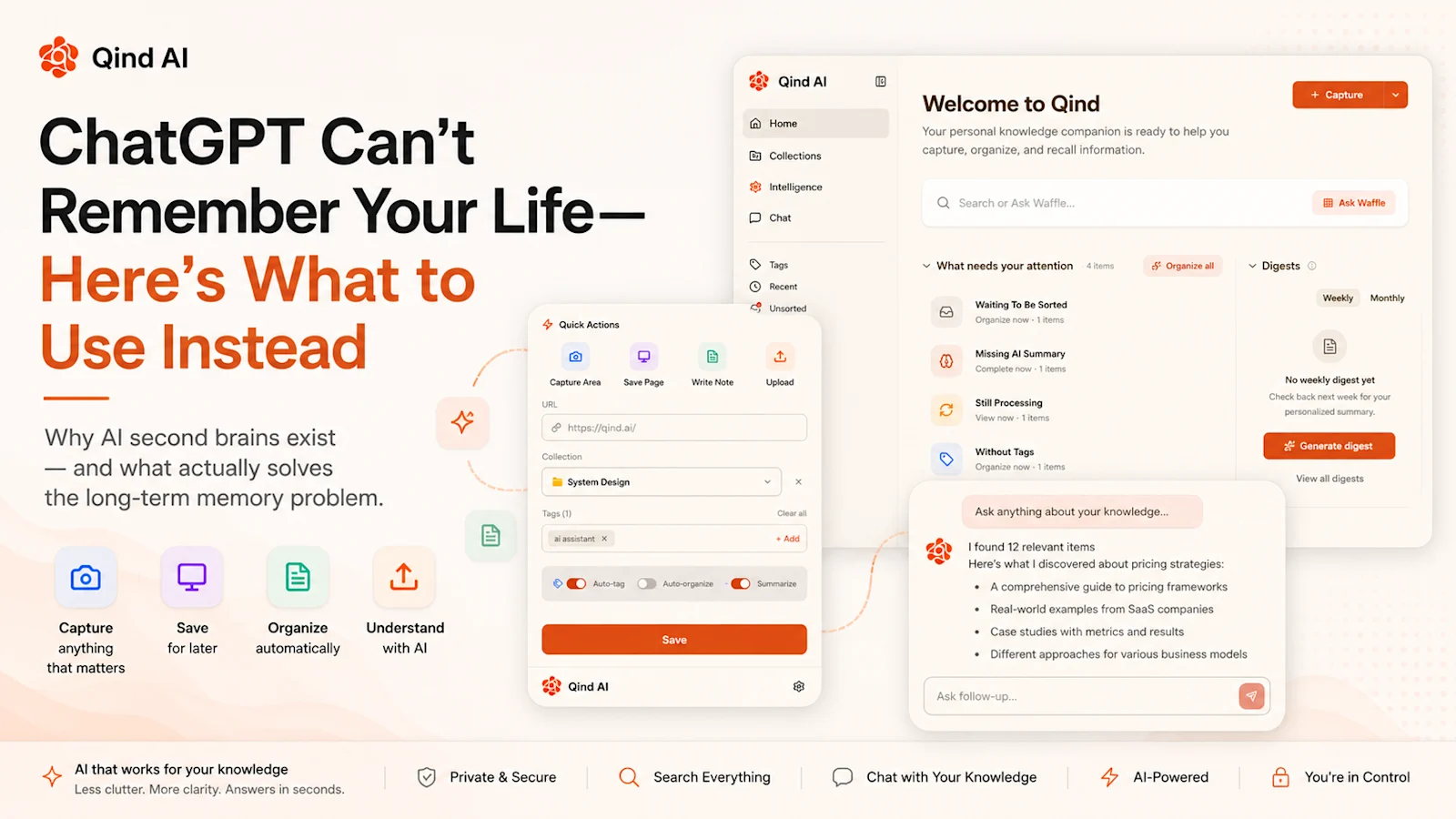
This is one of the problems we are working on with Qind. The idea is not to create another place where people manually organize hundreds of documents. Most knowledge workers already have enough places to store things.
The bigger challenge is connecting what they already collect and making that context useful later. A PM might save competitor research, product documentation, customer feedback, meeting notes, screenshots, articles, or internal observations. Individually, these are just pieces of information. Together, they form the reasoning behind product decisions.
Qind is designed to help turn that fragmented information into something that can be searched, questioned, and reused when the context becomes relevant again.
The important shift is simple: you should not have to remember where the information lives. You should be able to remember what you need to know.
The Best Product Teams Will Remember Better
Product management will always involve prioritization. There will always be too many ideas, too little engineering capacity, competing customer needs, and difficult tradeoffs.
But prioritization is only as good as the context behind it. The best product managers are not simply good at choosing between Option A and Option B. They understand the history behind those options. They know which assumptions have already been tested. They recognize patterns across customer conversations. They understand why previous decisions were made. They can connect research from months ago to the problem in front of them today.
That ability becomes even more important as products, teams, and companies grow. The future of product management may therefore depend less on building bigger backlogs and more on building better organizational memory.
Because before you can decide what to do next, you need to understand how you got here.