
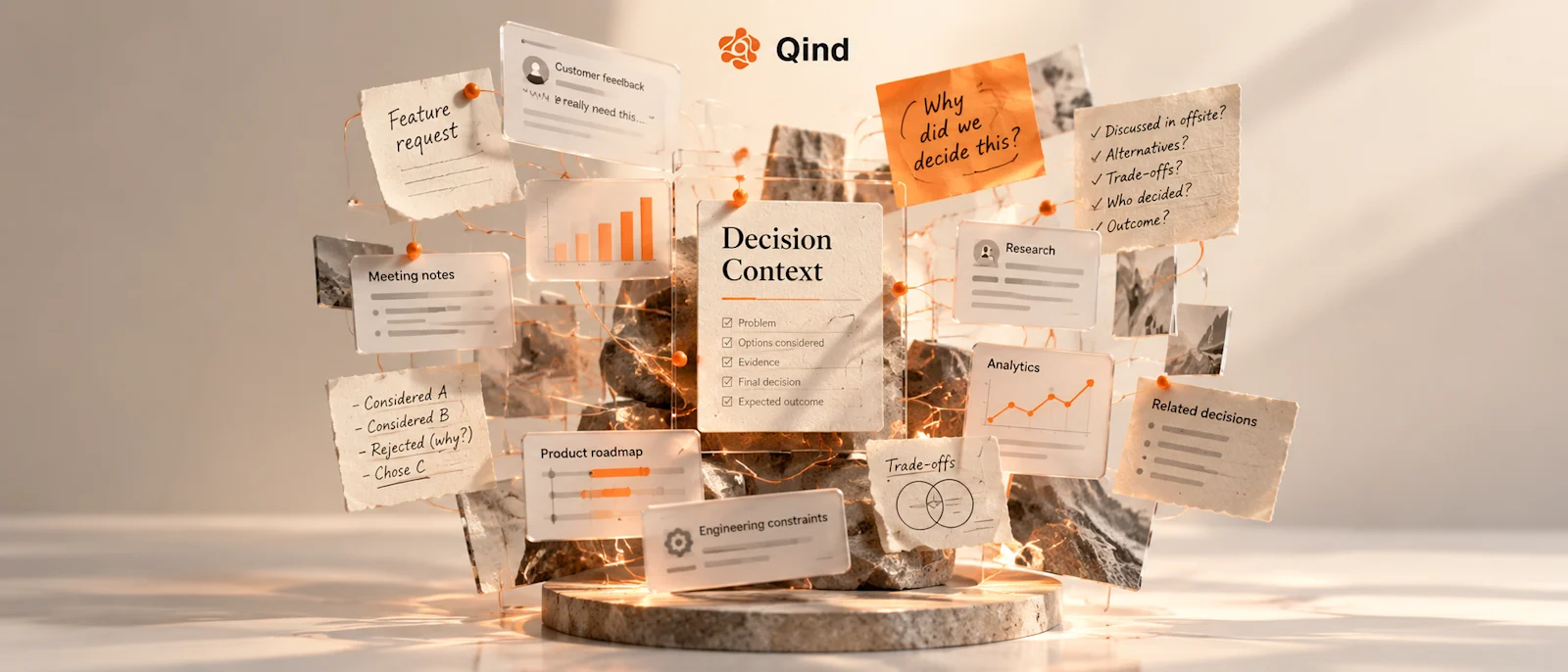
Every product team has experienced the same strange moment. Someone proposes an idea during a meeting, perhaps a new onboarding flow, a pricing change, an enterprise feature, or a technical redesign, and another person suddenly asks, “Didn’t we already discuss this?” Usually, the answer is yes. The problem is that nobody remembers exactly what was decided or why.
One person thinks the idea was rejected. Someone else remembers that it was postponed. An engineer vaguely recalls a technical limitation, while the product manager remembers customer feedback that influenced the discussion but cannot remember where it was documented. The meeting slowly turns into an investigation through Slack, Jira, meeting notes, research files, emails, and old documents.
At that point, the team is no longer deciding what to do next. It is trying to reconstruct what it already decided before. This is the forgotten decision problem, and it happens because product teams are usually much better at recording outcomes than preserving the reasoning that produced those outcomes.
The Decision Survives. The Context Does Not.
Most companies can tell you what was decided. A roadmap item was postponed, a pricing experiment was cancelled, a technical architecture was selected, or a customer request was rejected. What becomes much harder over time is understanding why that decision was made.
Imagine that a feature was postponed. Was the engineering effort too high? Was there not enough customer demand? Was the timing wrong? Did another initiative have greater strategic importance? These explanations lead to completely different conclusions when the topic appears again six months later.
Unfortunately, they often collapse into a single sentence: “We decided not to do it.” That sentence preserves the outcome but destroys most of the useful context. When circumstances later change, the team has no reliable way to determine whether the original reasoning still applies.
Product decisions are rarely permanent. Customers change, competitors change, technology changes, company strategy changes, and technical constraints disappear. When an old topic returns, the team needs to understand whether it is intelligently reconsidering a previous decision or simply repeating a conversation it has forgotten.
Why Product Decisions Are So Easy to Forget
Product decisions are rarely made inside one system. A discussion may begin with feedback collected by Customer Success, continue in Slack, receive supporting research in a document, gain an engineering estimate in Jira, and finally be resolved during a meeting. The roadmap may show the result, but it usually does not contain the complete reasoning behind it.
This creates a structural problem. Each tool may contain a valid piece of the story, yet no single place contains the full decision context. The information technically exists, but reconstructing it can require searching several systems and remembering how the pieces relate to one another.
As a result, teams often depend on individual memory. An engineer remembers why one approach was rejected. A designer remembers what happened during user testing. A PM remembers that a customer made an important request several months ago. This can work while the same people remain close to the project, but it becomes fragile when people move teams, leave the company, forget details, or simply are not available.
The decision stays inside the product. The reasoning often leaves with the people who carried it.
Reopening Old Debates Costs More Than Meeting Time
The most obvious cost of forgotten decisions is wasted time. A meeting spends twenty minutes discussing something that was already resolved six months earlier. A product manager searches old Slack channels. Engineering explains the same limitation again. Research is repeated because the original findings cannot be located.
The larger cost, however, is inconsistent decision-making. When the reasoning behind an earlier decision disappears, the same organization can reach completely different conclusions about the same issue without understanding why the conclusion changed.
For example, a feature might be rejected because it did not fit the product strategy. Six months later, another team may approve the same idea because the original strategic argument has disappeared from organizational memory. Sometimes changing the decision is absolutely correct because the market, customer base, technical environment, or strategy has changed. The problem is that without historical context, the team cannot tell whether reality changed or memory failed.
That distinction matters. A company should change decisions because new evidence justifies a different direction, not because nobody remembers why the previous decision existed.
Repetition Is Not the Same as Reconsideration
Strong product teams should reconsider old decisions. A choice made one year ago should not automatically remain correct forever. Product management requires teams to challenge assumptions and respond when conditions change.
The important difference is whether the reconsideration begins with context. A healthy discussion might sound like this: “We rejected this last year because only two customers asked for it and engineering estimated three months of work. Since then, eleven enterprise customers have requested it and the architecture has changed significantly. The assumptions behind the original decision no longer apply.”
That is productive reconsideration. The team understands the old reasoning, identifies what changed, and makes a new decision using updated evidence.
An unhealthy version sounds very different: “Why didn’t we build this before?” followed by “I’m not sure. Maybe we should do it now.” In that situation, the team is not reconsidering the decision. It is starting again from zero.
The difference is not documentation for documentation’s sake. The difference is the quality of the next decision.
Decision Logs Help, but Only When They Capture the Reasoning
Some teams try to solve this problem by maintaining decision logs. The idea is useful, but decision logs often become another document that people enthusiastically update for a few weeks and then gradually ignore. The problem is not necessarily the concept. It is what teams choose to record.
A decision record that contains only “Approved,” “Rejected,” or “Postponed” has limited long-term value. Future teams need enough information to understand the problem, the alternatives that were considered, the evidence that influenced the choice, the assumptions behind it, the tradeoffs that were accepted, and the conditions that would justify revisiting it.
That last point is particularly important. Many product decisions are conditional rather than permanent. “We will not build this because only two customers have requested it” is completely different from “We will never build this.” The first decision contains its own reconsideration trigger. If demand increases significantly, the team knows that the original assumption should be reviewed.
When decision rationale is preserved properly, the record becomes useful long after the original meeting has ended.
The Most Valuable Part of a Decision Is Often the Rationale
The final decision receives most of the attention because it determines what happens next. However, from the perspective of organizational learning, the reasoning behind the decision may be even more valuable.
Rationale connects evidence to action. It explains why one path was chosen over another and gives future teams a starting point instead of forcing them to reverse-engineer the past. It also prevents old decisions from becoming mysterious rules that people follow simply because “this is how we have always done it.”
Preserved rationale also makes product learning possible. A team can return later and ask whether its assumptions were correct, whether the expected outcome occurred, whether the risk was evaluated accurately, or whether customer demand developed as expected. Without the reasoning, the team can see what happened but has a much weaker basis for understanding why it happened.
This is one reason organizations can repeatedly make similar mistakes even when they have extensive documentation. They record what they did but lose the logic that produced the action.
Growth Makes the Forgotten Decision Problem Worse
Small companies can survive for a surprisingly long time using shared human memory. Everyone was in the same meetings, most people understand the history of the product, and asking why something happened may require nothing more than speaking to the founder or an engineer who has been there from the beginning.
That system does not scale. As the organization grows, product knowledge becomes distributed across teams, tools, locations, and time zones. New employees inherit products without inheriting the reasoning behind them. Documentation increases, yet shared understanding can actually decrease.
This creates a familiar pattern. A new PM sees an awkward workflow and assumes it was poorly designed. An engineer sees an architectural limitation and assumes nobody considered a better solution. A designer finds an old interface and assumes previous research was weak. Sometimes those conclusions are correct, but sometimes the existing solution reflects constraints that were entirely reasonable when the decision was made.
Without historical decision context, old choices often look irrational simply because the conditions that created them have disappeared from view.
AI Changes What Product Memory Can Become
AI creates an opportunity to move beyond traditional documentation. For years, preserving product knowledge meant maintaining folders, databases, wikis, notes, and carefully organized documents. The burden was placed largely on people to remember where information lived and how different pieces were connected.
That model can change. When the underlying context has been captured properly, AI can help teams retrieve and connect previous reasoning through natural questions. A product manager should eventually be able to ask, “Why did we postpone enterprise SSO?”, “What customer feedback influenced the pricing decision?”, “What concerns did engineering raise about this architecture?”, or “When did we last discuss changing onboarding?” without manually searching across several disconnected systems.
This is much more powerful than keyword search because the goal is not simply to find a document containing a phrase. The goal is to reconstruct the evidence and reasoning surrounding a decision.
There is still an important limitation. AI cannot reliably recover context that was never captured. If a thirty-minute discussion ends with a note saying only “not doing this for now,” there is very little reasoning available for any system to retrieve later. Better retrieval does not eliminate the need to preserve meaningful context in the first place.
From Documentation to Decision Memory
Product teams do not need more documentation simply for the sake of producing documents. They need usable memory. That means treating product decisions as connected knowledge rather than isolated outcomes.
Customer feedback should remain connected to the decisions it influenced. Research should remain connected to the hypotheses it supported or challenged. Technical constraints should remain connected to the compromises they created. Competitive changes should remain connected to the strategy conversations they triggered.
The objective is not to record every sentence spoken in every meeting. That would create more noise rather than more clarity. The goal is to preserve enough reasoning that someone returning to the subject months later can understand what happened without reconstructing the entire story from fragments.
That is the shift from documentation to decision memory.
Where Qind Fits
This is one of the problems Qind is designed to address. Product knowledge is usually scattered across research, web pages, notes, customer feedback, screenshots, observations, articles, and other sources. Each individual piece may seem small, but together they form the context behind important product decisions.
Qind helps capture and retrieve that accumulated context without requiring people to maintain another complicated manual knowledge system. Relevant information can be collected as the work happens and later questioned when the same subject becomes important again.
The difference becomes significant when an old discussion returns. Instead of beginning with “Where did we talk about this?” the team can begin with the far more useful question: “Why did we make this decision?”
That is where stored information becomes product memory rather than another archive.
Strong Product Teams Do Not Avoid Old Decisions. They Remember Them.
Good product teams are not teams that never reconsider previous choices. They are teams that can reconsider those choices without losing the reasoning that came before.
They understand what was decided, why it was decided, what evidence influenced the choice, what assumptions were made, and what circumstances would justify changing direction later. That creates faster discussions, better alignment, stronger onboarding for new team members, and more consistent product decisions.
Most importantly, it turns previous work into an asset instead of forcing the organization to rediscover its own history every few months.
The discussion may return. The market may change. The evidence may become stronger. The final decision may even be completely different next time.
But the reasoning should still be there.