Taking notes during a meeting seems simple.
You open a notebook, grab your laptop, or start writing in a document. Then the meeting begins.
Someone starts speaking.
You write something down.
Someone else asks a question.
You write that down too.
Someone changes the subject.
You're still trying to finish the previous sentence.
And then suddenly you realize you're so preoccupied with taking notes that you're not even part of the conversation.
Sound familiar?
For many people, taking good meeting notes feels almost like a special skill. You have to listen, understand, decide what's important, write quickly, and at the same time keep everything organized somehow.
And you have to do all this while the meeting is in progress.
The Problem Isn't Writing It Down
The biggest mistake people make with meeting notes is trying to write everything down.
It sounds logical. If something is said during a meeting, it must be important, right?
Actually, it's not.
Most meetings involve a mix of important decisions, useful context, recurring points, random thoughts, questions, side discussions, and things that will never be mentioned again.
Trying to capture all of this is exhausting.
Good meeting notes are not a transcript.
They are a filtered version of the conversation.
The hard part is deciding what deserves to stay.
Was this comment important?
Was this a decision?
Was someone just thinking aloud?
Is there an action item here?
Who is responsible for this?
When does it need to be done?
These decisions are forming in your head at the same time you're trying to follow the conversation.
That's why good note-taking can be harder than it seems.
You Must Listen and Write Simultaneously
There's another problem that arises when you think about what's actually happening during the meeting.
You're doing two different things at once.
You're trying to understand what people are saying while simultaneously trying to turn that information into something useful on the page.
And these two activities are competing for your attention.
If you focus too much on writing, you might miss the next important point.
If you focus entirely on listening, you might forget what was said before you have a chance to write it down.
This can be very frustrating, especially if you have attention deficit disorder or easily lose your flow of thought. And yes, if you have ADHD, you probably understand exactly what I mean. :)
Sometimes, three perfectly written lines of notes are followed by:
"something about the deadline??"
At the time, it seemed perfectly understandable.
Usually, two hours later, it doesn't.
Writing Fast Is Not the Same as Taking Good Notes
Speed matters.
Especially when several people are speaking or the conversation is moving quickly, you can't keep up with the pace of people talking.
That's why we start developing shortcuts.
Half sentences.
Random abbreviations.
Missing words.
Arrows.
Question marks.
Capital letters for things we absolutely must remember.
And then there's the handwriting problem.
If you quickly take notes in your own handwriting, it's very likely your future self won't be able to read them.
At the end of the meeting, you look at the page and think:
"I definitely understood this while writing it down."
Your future self won't agree.
This is one of the most overlooked aspects of note-taking.
Notes aren't just written for your present self. They're written for your future self.
And tomorrow, you won't remember the context that showed why those messy notes were clear.
What Should Really Be Included in Meeting Notes?
There's no perfect structure for every meeting, but there are almost always a few things worth recording.
Decisions
If the team made a decision, write it down.
This is probably one of the most valuable parts of any meeting.
People often remember the discussion differently. A written decision eliminates unnecessary confusion later.
Action Items
If there's something that needs to be done after the meeting, record it.
More importantly, record who is responsible for it.
The phrase "fix the problem" isn't a useful action item if it's not clear who needs to fix it.
Questions and Open Issues
Not everything is resolved in a meeting.
Some questions remain unanswered. Some decisions require more information.
It's worth recording these because they are often things that come up again in the next meeting.
Important Context
This is the part people often skip.
Sometimes the decision itself isn't enough.
You also need to remember why the decision was made.
A few weeks later, someone might ask:
"Why did we decide to do it this way?"
If your notes only contain the final decision, you may need to reconstruct the entire conversation from memory.
Good notes preserve enough context to prevent this.
The meeting ends. The work doesn't.
That's where meeting notes become a real problem.
Taking notes is only the first half.
After the meeting, you need to do something with them.
You may need to clean them up.
Turn the notes into tasks.
Send a summary to someone.
Add important information to a project.
Find an old decision.
Check what was agreed upon three weeks ago.
And that's where many meeting notes get lost.
They end up in a document with a title like this:
Meeting — March 14
And that's it.
No one looks at it again.
Until three months later someone asks:
"Didn't we talk about this before?"
Now you have to sift through old documents, messages, calendars, and probably several different note-taking apps to find that single conversation.
The meeting happened once.
But finding and reconstructing what happened could take several more hours.
Perhaps We Expect Too Much from Note-Taking
This raises an interesting question.
Why do we still expect people to manually capture, organize, summarize, and remember every important part of a conversation?
We already have technology that can record a meeting.
We already have technology that can transcribe the conversation.
The next logical step is to make that information actually useful.
Instead of a massive transcript that nobody wants to read, we should be able to get the key parts of the conversation:
What was discussed?
What was decided?
What is supposed to happen next?
Who is responsible?
What should we remember?
And perhaps most importantly:
Can I find this conversation again when I need it?
Your Notes Should Work for You
Good meeting notes should reduce the mental burden, not create it.
You shouldn't have to remember exactly what someone said three weeks ago.
You shouldn't have to decipher your own handwriting.
You shouldn't have to search five different tools to find a decision.
And you shouldn't have to spend the first 20 minutes after every meeting transcribing your notes into something readable.
The meeting is already over.
Useful information shouldn't be lost because you didn't write fast enough.
That's where Qind becomes more than just another place to take notes.
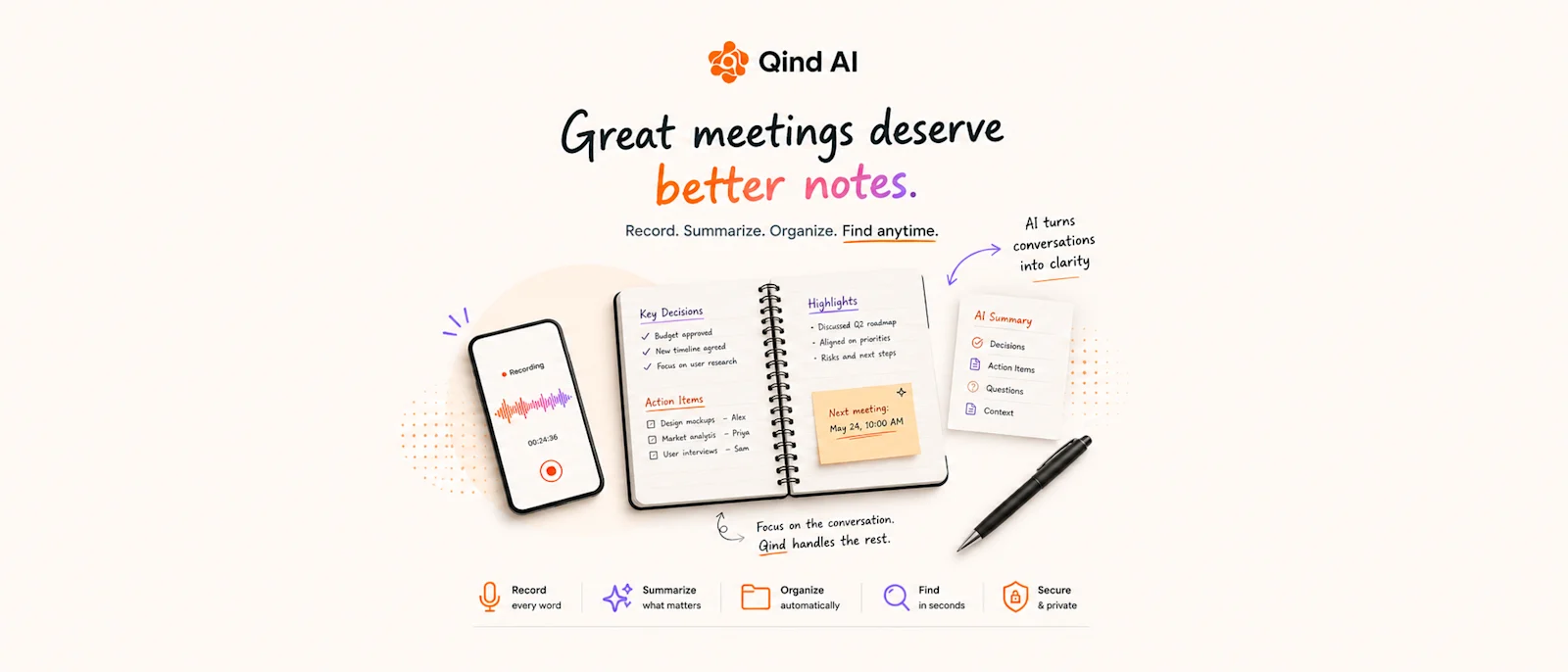
Qind can record the entire meeting, turn the conversation into a structured summary, and organize the resulting notes so they can be found and used later.
Because perhaps the best meeting notes aren't the ones you manage to write perfectly.
This is a method you can find, understand, and use even after the meeting is long over.