Every creator, marketer, and writer knows the feeling:
Whether you're scrolling through Twitter at 11 a.m. or reading a newsletter with your morning coffee, you come across a clever sentence, an informative graph, or a compelling case study. "This would be perfect for a future article," you think.
So what do you do?
You take a screenshot that disappears into a folder with 4,000 other images.
You bookmark the tweet, never to look at your bookmarks tab again.
You dump a half-formed thought into a blank Apple Note named "Ideas (2)".
Two weeks later, you sit down to write. You stare at a blinking cursor. The dread of Writer’s Block sets in—not because you don't have good ideas, but because your ideas are trapped in digital clutter.
In 2026, the secret to consistent, high-quality content creation isn't raw willpower. It's moving from passive bookmarking to an active AI inspiration bank.
The Bookmark Graveyard: Why Saving Isn't Enough
The fundamental problem with traditional bookmarking apps, read-it-later tools, and camera rolls is that they are one-way streets. Information goes in, but it rarely comes back out when you need it.
When you accumulate 50 articles a month, you're creating a haystack. When you sit down to write, finding a particular quote or insightful graphic requires digging through the entire haystack.
Because searching through messy notes takes too much friction, your brain gives up and defaults to staring at a blank page.
Passive Capture, Active Context: The New Creator Workflow
To build a sustainable content engine, your second brain needs to do three things automatically:
Capture Multimodal Inputs: Ideas aren't just text. They are infographics, screen recordings, podcasts, and casual thoughts.
Understand Visual & Unstructured Context: An inspiration bank should understand what an image means, not just what file name it has.
Resurface Ideas via Natural Prompts: When you start writing about a topic, relevant inspiration should come to you.
This is where an intelligent core like Qind AI transforms the creative process.
How Qind AI Eliminates Writer's Block
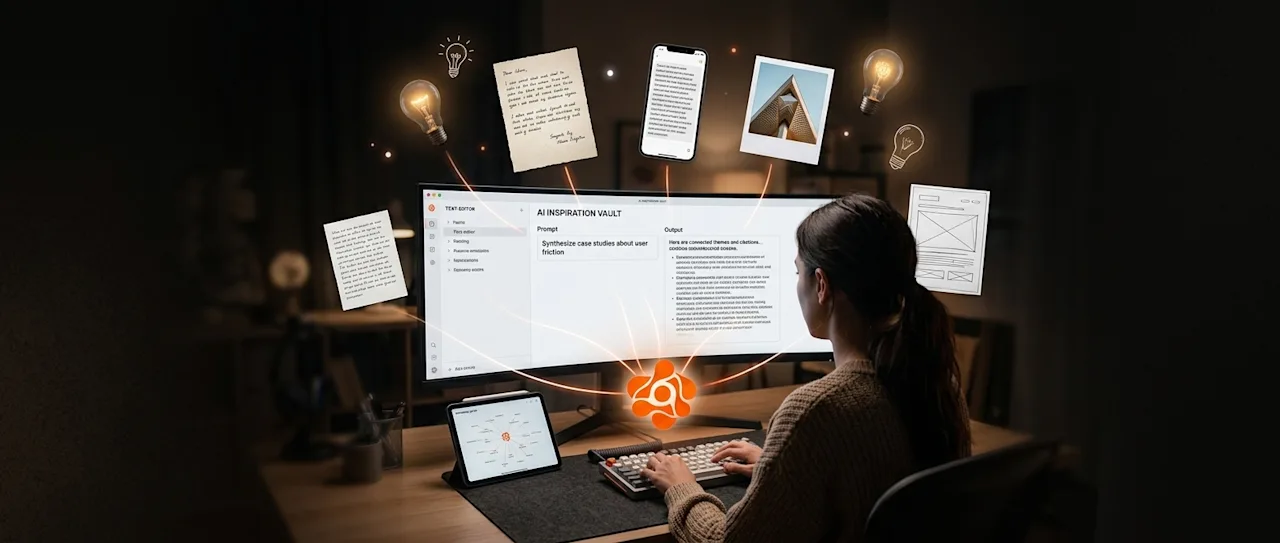
Instead of spending hours organizing tags, subfolders, and color codes, you treat Qind AI as a dynamic vault:
Drop Anything In: Save a web snippet, paste a article link, or upload a rough voice note.
Ask for Brainstorming Support: Instead of staring at a blank document, query your vault:
"Pull all the case studies and quotes I saved last month about product pricing strategies."
Synthesize into Drafts: Qind AI cross-references your saved notes, extracts the core arguments, and cites your exact sources—giving you a rich, structured outline in seconds.
3 Steps to Build Your AI Inspiration Bank Today
Stop Categorizing, Start Hoarding: Whenever an article or tweet sparks an emotion or thought, save it directly to your unified repository. Don't worry about where it belongs—AI will index its meaning.
Use Natural Prompts to Outline: When starting a new piece, begin by asking your repository questions about the topic to see what past inspiration you've already accumulated.
Turn Fragments into Outlines: Combine 3–4 saved snippets with a single prompt to generate an initial structure, skipping the intimidating "blank page" phase entirely.
Creativity is Recombination
Great writing doesn't just appear out of nowhere; it's the result of a creative recombination of existing ideas, personal perspectives, and research.
When your saved inspiration is indexed, searchable, and instantly retrievable, Writer's Block ceases to exist. You are no longer staring at a blank canvas—you are curating a conversation with your past self.