If you are a product manager or user experience researcher, you are essentially a professional information intermediary.
Every day, you are bombarded with data from ten different directions:
User feedback snippets from Slack and Intercom.
Deep-dive competitor analysis reports.
Market trend articles from LinkedIn and industry blogs.
Complex Product Requirement Documents (PRDs).
Analytics dashboards from Mixpanel or Amplitude.
This is a relentless flood of information. Your job isn't to read everything; it's to synthesize it and extract actionable insights. In 2026, relying on manually organized folders, static Google Docs, or disorganized bookmark folders will no longer be a viable strategy.
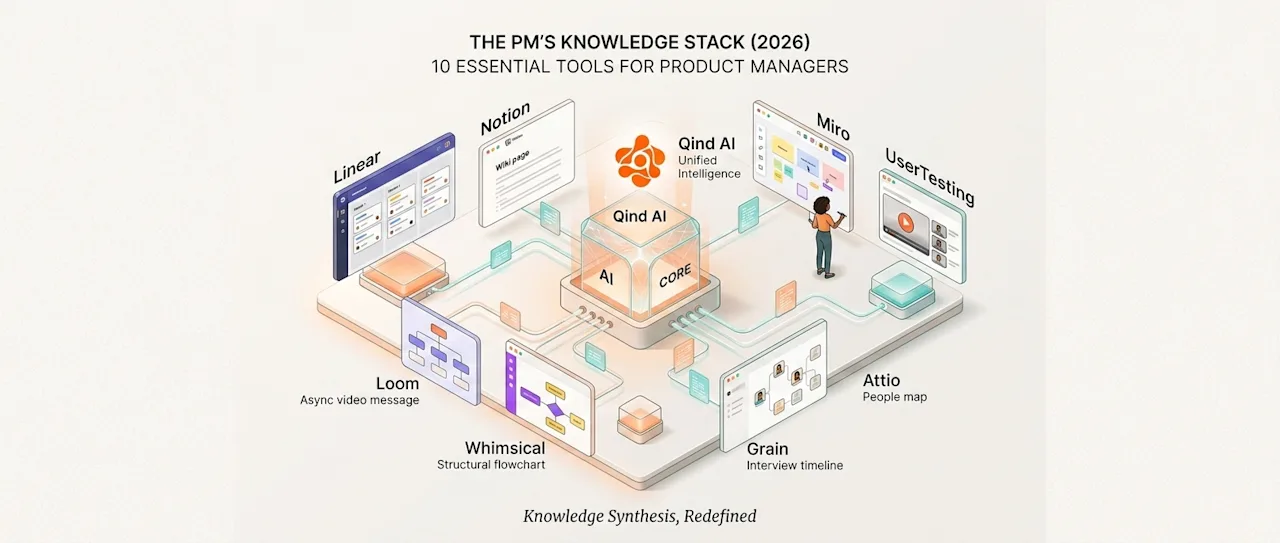
To make faster, data-driven product decisions and reduce information delay, you need a new "Product Stack." Here are 10 essential information management tools that are transforming the way product managers and researchers work.
The New Intelligence Stack: From Capture to Action
1. Qind AI: The Unified Intelligence Repository (The AI retrieval layer)
Qind AI acts as the glue that binds all your other tools together. It's not just an app or database you can read later; it's a layer of semantic intelligence. Whenever you find a user review, product requirements document, or competitor analysis, you can submit it to Qind AI.
The Magic: When you need a data point weeks later, you don't need to remember where you saved it or what it was called. You ask in natural language:
"What were the three biggest user complaints about the checkout screen last quarter?"
The system understands your intention and retrieves specific excerpts and summaries from all your saved documents, reducing access time to zero.
2. Linear: Integrated Roadmap and Documentation (For context)
In 2026, tightly interconnected workflows will be a must-have for project management tools. Linear has proven itself by combining incredibly fast issue tracking with minimalist project documentation. Because information and tasks are in one place, project managers can spend less time on synchronization and more time on development.
3. Notion (with Notion AI): Dynamic Team Knowledge Base
Notion remains an excellent, highly flexible workspace for product requirements documents (PRDs), wikis, and research databases. What will make it indispensable in 2026 is its maturing AI integration. Users can summarize research calls, transform drafts into clearer requirements, and even suggest links between different documents.
4. Miro (Miro AI): Visualizing Abstract Ideas
For researchers and project managers, ideas often begin visually. Miro's digital canvas is indispensable for mapping user flows and creating storyboards. New AI features can automatically cluster sticky notes from brainstorming sessions, generate entire project canvases, and even transform simple text prompts into diagram structures, instantly making sense of visual clutter.
5. UserTesting: In-Context Qualitative Insights
You need highly accurate qualitative data to manage information about who you're developing products for. UserTesting allows researchers and product managers to quickly collect and manage screen recording data. When these sessions are translated into larger product theories (using tools like Qind AI), UserTesting becomes indispensable.
6. Attio: The 'People' Database for Knowledge
Product information isn't just about documentation; it also involves stakeholders and beta users. Attio is a modern CRM that lets you map your relationships with beta testers, categorize feedback sources, and associate specific product requirements with the people requesting them.
The Synthesis & Collaboration Layers
7. Grain: AI-Powered Research Synthesis
Grain automates the quantitative synthesis of research interviews. By 2026, instead of a simple transcript, Grain will be generating "summary videos" using advanced AI, automatically tagging key themes (e.g., "usability bug" or "new feature idea"), and directly synchronizing these snippets of information into tools like Notion or Linear.
8. FigJam (by Figma): Connected Brainstorming
Research findings from FigJam are crucial. FigJam allows visual data from UX research to seamlessly flow into brainstorming sessions. Project managers can link design prototypes directly to brainstorming notes, creating a direct connection from user feedback to final design decisions.
9. Whimsical: Structuring Complex Systems
When documentation is extensive, a good diagram is invaluable. Whimsical is the ideal tool for creating clean, structured flowcharts, mind maps, and interface designs. Its simplicity makes it an excellent information management tool for communicating system complexity to engineering teams.
10. Loom: Asynchronous Video Context
Sometimes the best documentation isn't a document, but a short video. Product managers use Loom to provide asynchronous context about new features, explain PRDs, or share research findings. A shared Loom link acts as a persistent piece of visual context, eliminating incongruous meetings.
Closing thoughts: Synthesize, Don't Just Store
The challenge for the modern Product Manager isn't finding tools to save information. The challenge is connecting them.
The core toolset for 2026 is about creating a symbiotic relationship between your data capture tools (Linear, Notion, Loom) and your intelligent knowledge retrieval tools (Qind AI). The real winners won't be the teams with the most tools, but those that can acquire and synthesize information the fastest.