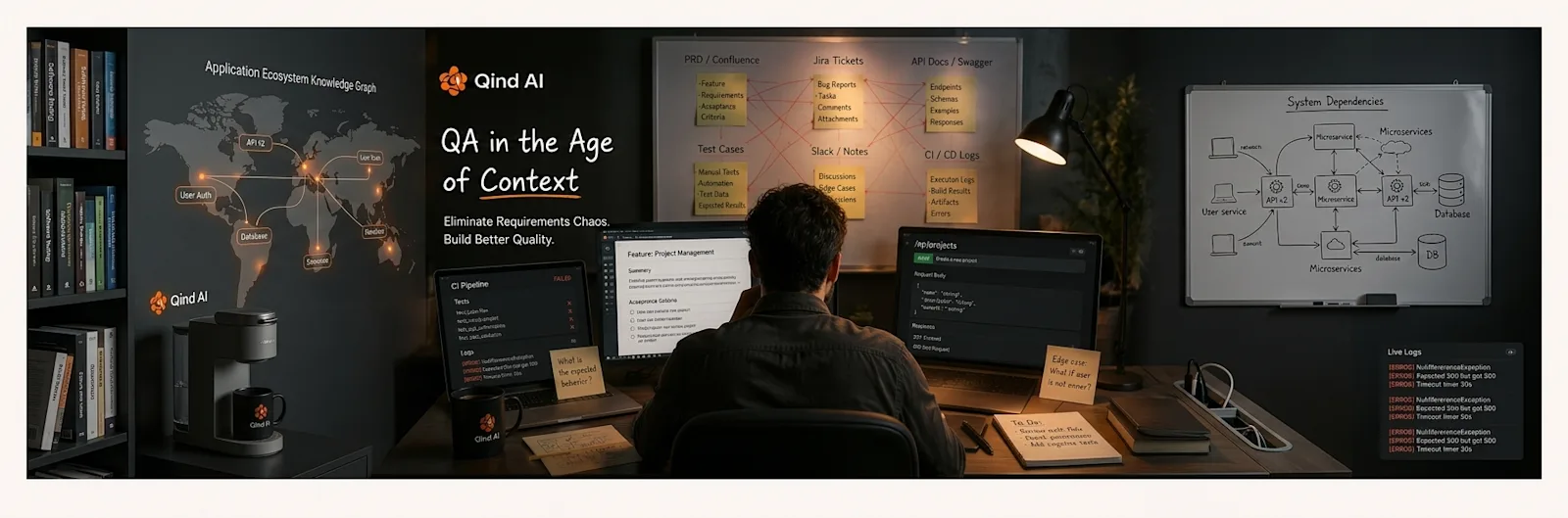
If you work in Software Quality Assurance (QA) or Test Automation, you probably spend more time searching for information than you'd like to admit. A Jira ticket tells you what changed, a PRD tells you what was intended, Swagger or OpenAPI tells you what the API exposes, a test case tells you what you decided to verify, and a CI/CD log tells you what actually happened. And somewhere in the middle, there is probably a Slack conversation explaining an important edge case that nobody documented properly.
The problem isn't that this information doesn't exist; the problem is that it's scattered everywhere. When a bug appears or a regression test suddenly starts failing, QA engineers often have to jump between Jira, Confluence, Swagger, test management tools, source code, CI logs, and old conversations just to answer one basic question: "What was the software actually supposed to do?"
As software systems become more complex, this context problem is becoming a bigger part of the QA job.
The Hidden Tax of Context Switching
Traditional QA workflows depend heavily on documentation, and documentation is usually fragmented:
Requirements might live in Confluence.
Bugs live in Jira.
API contracts live in Swagger.
Test cases live in a test management system.
Automation code lives in GitHub.
Execution results live in Jenkins or GitHub Actions.
Important decisions might exist only in Slack or meeting notes.
Each tool works perfectly well on its own—the problem starts when you need information across all of them. Imagine that an API behavior has changed: a developer updates the endpoint, the Jira ticket describes the change, but the PRD still contains the old behavior. Your automated test was written six months ago. Someone mentioned an edge case during a meeting three months ago, but nobody added it to the test case.
Now the test fails. Is it a bug? Is the test outdated? Was the requirement changed intentionally? Or did the developer implement something incorrectly? Before you can test anything, you need to reconstruct the context. That's where QA loses a surprising amount of time.
QA Is About Understanding Intent
It's easy to think of QA as executing test cases, but experienced QA engineers know that testing is much more than that. The real job is understanding intent. You need to understand why a feature exists, what behavior is expected, what assumptions were made, and what can go wrong when those assumptions change.
That's why having 500 test cases doesn't necessarily mean you have good test coverage. A test case without context can become just another piece of outdated documentation. Consider a simple test: "Verify refresh token expiration after 30 minutes."
Six months later, someone asks: "Why 30 minutes?" The answer might not be in the test case. It might be in a security discussion in Jira, a product requirement, a technical decision, or a meeting note. The test tells you what you're checking; the surrounding context tells you why. And that "why" is often what disappears first.
From Static Documentation to Searchable Context
This is where AI-powered knowledge tools can become useful for QA teams. Instead of treating requirements, bug reports, technical documentation, meeting notes, and other information as isolated documents, you can build a searchable repository of the context surrounding your product.
For example, you can save:
Product requirements and API documentation
Release notes and bug reports
Technical decisions and investigation notes
Important edge cases and documentation from previous releases
With a tool like Qind AI, this information can be captured and organized with AI-generated summaries, tags, and collections. More importantly, you can search the saved information by meaning rather than relying only on exact keywords.
That changes how you investigate problems. Instead of remembering exactly where something was documented, you can ask natural questions such as:
"What was the original behavior expected for OAuth2 refresh tokens?"
"Why was the refresh token expiration changed?"
"What edge cases were previously discussed for this endpoint?"
The goal isn't to have AI make the testing decision for you—the goal is to make the information you need easier to find.
Faster Requirement Investigation
One of the most common situations in QA is investigating whether something is actually a bug. A test fails, and the application behaves differently from what you expected. Your first reaction might be: "The developer broke something." But before reporting the bug, you need to check the requirement. Maybe the requirement changed, the expected behavior was misunderstood, the API contract was updated, or the behavior was intentionally changed during a previous release.
This investigation can involve several sources of information. A searchable knowledge repository reduces the time spent manually looking through those sources. Instead of starting every investigation from zero, QA engineers can build on the context they've already collected—which is particularly useful for long-running products where requirements, architecture, and team members change over time.
Better Regression Planning
Requirements rarely stay still; a small change to one feature can affect existing functionality somewhere else. The challenge isn't simply finding the changed Jira ticket—the challenge is understanding what existed around that change:
What behavior did the system have before?
Were there known edge cases or bugs previously reported in this area?
Was there a technical decision that explains the current implementation?
Which scenarios were considered important when the feature was originally released?
Keeping this information together makes regression planning far more informed. You may still need to inspect the code, update automation, run the tests, and make the final QA decision yourself, but you don't have to spend as much time reconstructing the history first.
Keep the Reasoning Behind the Test
This may be one of the most overlooked parts of QA documentation: test cases tend to survive, but the reasoning behind them often doesn't. A test might say: "Verify that a user cannot access another tenant's data."
That's a good test, but why is this scenario particularly important? Maybe there was a serious security issue two years ago, tenant isolation was redesigned after an incident, or a previous implementation accidentally allowed data from another tenant to appear in search results.
That context matters. Without it, someone reviewing the test six months later might decide that the scenario is unnecessary. The test case survived; the reason for the test didn't. Capturing important decisions, bug investigations, meeting notes, and technical context alongside your normal QA documentation helps preserve that reasoning.
This is where a knowledge-management tool such as Qind can be useful—not as another test management system, but as a place to keep and retrieve the context surrounding your testing work.
Quality Engineering Is About Clarity, Not Volume
Modern QA isn't about creating more and more test cases; it's about having the right context to make better testing decisions. A thousand outdated test cases won't help if nobody knows which requirements they represent. A small, well-maintained regression suite can be far more valuable when the team understands why those scenarios exist and what risks they cover.
The same applies to documentation: the goal isn't to document every conversation or save every piece of information. The goal is to make important context available when you need it. AI can help reduce the manual effort involved in capturing, organizing, summarizing, and retrieving that information, but it shouldn't replace the QA engineer's judgment.
AI can help you find the context; QA still decides what that context means.
The Future of QA: Testing Smarter and Understanding Faster
Requirements will change, APIs will evolve, Jira tickets will be closed, test suites will grow, people will join and leave teams, and documentation will inevitably become outdated. That's normal. What shouldn't disappear so easily is the context behind those changes.
Good QA isn't about knowing every detail of the system—it's about being able to find the right detail when you need it. That's where tools like Qind can help: not by replacing the QA engineer, but by making the information around the system easier to capture, organize, and retrieve.
Because sometimes the hardest part of testing isn't finding a bug—it's figuring out what the software was supposed to do in the first place.